
Queenscliffe’s 2031 zero-carbon goal is more than a local target. When one community keeps its word, it gives others reason to act. So whether it keeps that promise matters far beyond the Borough.
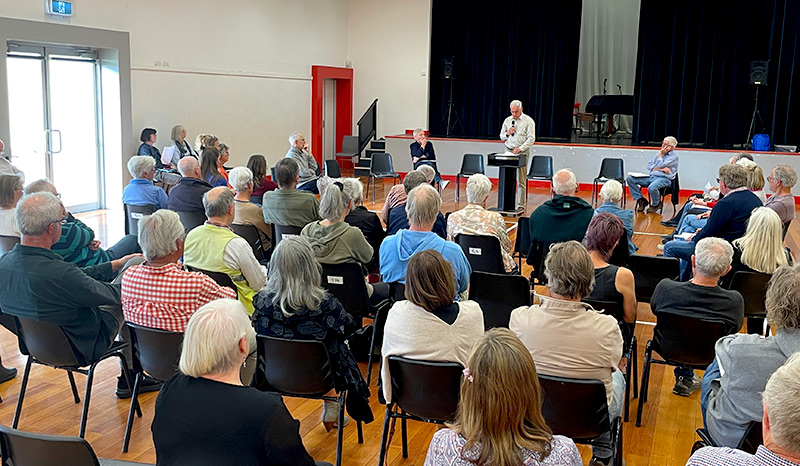
I went to a community meeting at Point Lonsdale Primary School expecting the organisers and perhaps a handful of others. Instead, every chair was taken. People had come because they were worried about what might happen to the Borough of Queenscliffe’s Climate Emergency Response Plan.
Some were plainly frustrated. I understood why. They had helped create a plan with their neighbours, local groups, businesses and council. They had given it their time and their trust. Five years later, they wanted to know whether the promise at its centre would survive – the promise to make the borough a zero-carbon community by 2031.
It did not appear out of thin air. Council declared a climate emergency in December 2019. In 2020, 346 people responded to a survey, schoolchildren took part in a workshop, and a community panel helped shape the plan. After further public consultation, council adopted it in May 2021, with numerous actions covering energy, buildings, transport, resilience, waste and care for Country. It also addresses the risks of coastal flooding, rising seas and bushfires. The plan was reviewed and updated in 2023.
It was an ambitious plan, and that was the whole point. Queenscliffe was asking what a small coastal community could do if it faced the climate emergency together and started now, while there was still time to avoid some of the harm.
A new ‘strategy’
Queenscliffe Council is currently conducting a five-year review and says it will use the process to develop a new ‘Climate Strategy’. It has held a listening session and two roundtables with participants selected independently through an open expression of interest. It also says the draft strategy will go on public exhibition. These are opportunities to contribute. Yet the Queenscliff and Point Lonsdale residents I listened to at the meeting said they wanted a clearer answer to a basic question: what, exactly, is being reviewed, and is the 2031 commitment still the destination?
There are sensible reasons to examine the plan. Some actions will have worked better than others. Technology, costs and responsibilities have changed. A review should show what has been completed, what is under way, what has stalled – and why. It should put the existing targets and each proposed change in front of the community, in plain language, before any replacement is settled.
Otherwise a new document could quietly take the place of an old promise without anyone having had a fair chance to judge what was gained or lost.
A values test
Since Queenscliffe adopted its plan in 2021, the political winds have shifted. Donald Trump has made climate denial a badge of loyalty: dismiss the science, sneer at people trying to protect their communities, and insist that every serious response is too expensive.
That script has admirers in Australia. But it cannot hold back the sea at Queenscliff or make the cost of inaction disappear. It merely passes that cost to someone else – above all, to children who had no say in the decision.
Nor does the familiar claim that renewables are too costly and unreliable survive scrutiny. CSIRO and AEMO identify renewable energy, backed by storage and transmission, as Australia’s least-cost path to a reliable electricity system as ageing coal stations retire. Pretending those stations are a permanent answer will not make them younger or shield households from volatile fossil fuel prices.
That is the values test for anyone who wants to weaken the 2031 commitment. If you believe it cannot be met, show the evidence and make your case openly to the people who helped create it. Do not quietly repackage a retreat as a ‘new strategy’. There is nothing responsible about leaving the hard work and the bill to the next generation, then calling it prudence.
Community survey
Council has not announced a decision to abandon the target. Not yet, anyway. We have not seen the new strategy. But a new title should never do the work of a public decision. If council intends to keep the 2031 target, it should say so plainly. If it intends to change that target, it should explain why while the community can still have a meaningful say.
At the community meeting, 21 people put up their hands to help deliver a survey to local letterboxes. A survey of this kind would not be a referendum or a scientific poll. It would, however, give many more households a chance to be heard. When people volunteer to knock on doors for a question like this, council should recognise what it says about their desire to be involved.
A part to play
Nearly ten years ago, I helped communicate the climate emergency declaration campaign that led to Darebin City Council’s declaration in December 2016 – the first by a government anywhere in the world.
Since then, more than 2,300 governments have made declarations of their own. One council did not solve climate change. But it helped others see that they, too, had a part to play.
That lesson feels especially relevant after the latest UN climate conference in Türkiye. Governments made progress on some matters, but they failed to agree on the conference’s overarching climate decision. We still need international and national action on a much larger scale. We also need communities willing to do the work in front of them.
Three million heat-related deaths
The human cost of delay is already here. The 2026 Lancet Countdown estimates that human-caused climate change contributed to almost three million heat-related deaths worldwide between 2016 and 2023. These are modelled estimates, not a tally of individual death certificates. Even allowing for that distinction, the scale is hard to take in. This is happening on our watch. Not in some distant future.
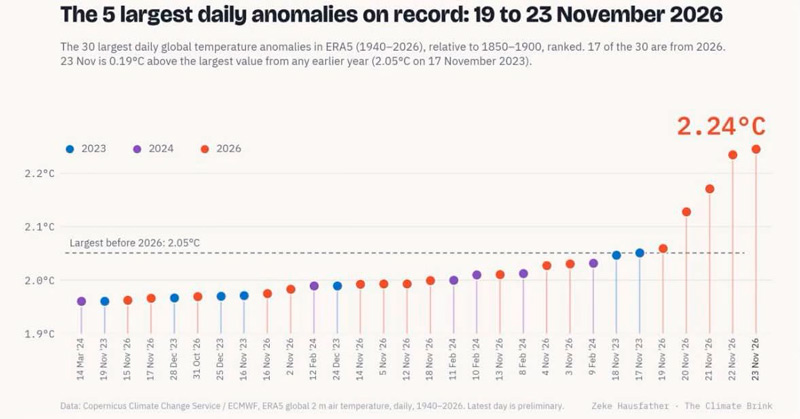
August 2026 equalled the hottest month ever recorded globally, capping western Europe’s hottest summer on record. Earth is also reflecting less sunlight back into space. Measurements by NASA and NOAA found that the imbalance between the energy Earth absorbs and the energy it releases roughly doubled between 2005 and 2019, faster than many climate models simulated.
Disasters of all kinds cause about US$202 billion a year in direct economic losses, according to the UN Office for Disaster Risk Reduction. Once indirect and ecosystem costs are counted, it estimates the annual total at more than US$2.3 trillion. A World Bank study estimates that climate change could push up to 132 million additional people into extreme poverty by 2030.
The Institute and Faculty of Actuaries warns that, under current policies, global GDP could contract by around 50 per cent between 2070 and 2090. That is a risk scenario, not a certain forecast.
Power of the exemplar
Queenscliffe cannot solve this crisis on its own. But every tonne of carbon kept out of the atmosphere matters, and every example of a community keeping its word makes it easier for another to act.
A community solar programme has helped households make changes, and four neighbourhood batteries are being planned. The borough has something to build on.
I do not live in Queenscliffe, and the decision belongs to the people who do. What I saw in that meeting hall was a community asking to be treated as a partner in a plan it helped make. Show them the work. Let them see the choices. If the 2031 promise is to change, explain why and ask them before it does.
Sources
→ Borough of Queenscliffe – May 2021:
Developing our Climate Emergency Response Plan – About the project
→ Borough of Queenscliffe – August 2026:
Climate Emergency Response Plan 5-Year Review
“We’re conducting a review of our Climate Emergency Response Plan (CERP). We are now taking Expressions of Interest for our roundtable sessions.”
→ Borough of Queenscliffe – August 2026:
Climate Emergency Response Plan
→ Queenscliffe Climate Action Now:
Community Solar Program
“Helping 3225 homeowners and businesses to make the switch to clean, affordable energy”
→ Darebin City Council – 2024:
Darebin Climate Emergency Plan 2024-2030
→ United Nations – 23 November 2026
COP31 delivers important progress across negotiations and Action Agenda, advancing implementation, but fails to agree Presidency-Led Decision
→ UCL – 6 November 2026:
The 2026 report of the Lancet Countdown on health and climate change: a decade of escalating health harms and a decisive moment for all
→ ABC News – 28 October 2026:
Global Lancet study counts almost 3 million climate change-related deaths
“A new Lancet report has found the number of heat-related deaths has been growing since the 2015 Paris Agreement, despite real gains from the climate pact. It says climate action is not keeping pace with increasing health impacts as the world keeps burning fossil fuels.”
→ Copernicus:
Surface air temperature for August 2026
“August 2026 was the warmest August on record globally.”
→ NASA – 15 June 2026:
Joint NASA, NOAA Study Finds Earth’s Energy Imbalance Has Doubled
“Researchers have found that Earth’s energy imbalance approximately doubled during the 14-year period from 2005 to 2019.”
→ United Nations – 8 June 2026:
A new framework to count the cost of disasters to nature
“While officially reported global direct economic losses stand at approximately $202 billion annually, the Global Assessment Report on Disaster Risk Reduction 2025 estimates that the true cost of disasters rises to more than $2.3 trillion when indirect, cascading and ecosystem impacts are taken into account.”
→ World Bank – 12 November 2025:
Impact of Climate Change on Health
The links between climate, poverty and health are clear. The climate crisis is a health-risk multiplier. Extreme weather events are devastating health globally. By 2030, climate’s negative health effects could drive at least 44 million people into extreme poverty.
→ Institute and Faculty of Actuaries – 16 January 2025:
Current climate policies risk catastrophic societal and economic impacts
“The global economy could face a 50% loss in GDP between 2070 and 2090, unless immediate policy action on risks posed by the climate crisis is taken. Populations are already impacted by food system shocks, water insecurity, heat stress and infectious diseases. If unchecked, mass mortality, mass displacement, severe economic contraction and conflict become more likely.”
→ Mondo – 2024:
Neighbourhood Batteries Program Queenscliffe
“Mondo will be delivering a total of four Battery Energy Storage Systems (BESS) to support the Borough of Queenscliffe.”
→ CSIRO – 15 July 2026:
GenCost 2025-26: Renewables and storage a source of stability amid global uncertainty
“Now in its eighth year, the annual report provides Australia’s most comprehensive assessment of the costs of new-build electricity generation, storage and hydrogen technologies.”