Podcast: Download (Duration: 54:04 — 49.9MB)
Subscribe: Apple Podcasts | Spotify | Android | RSS | More
The Sustainable Hour no. 614 | Transcript | Podcast notes
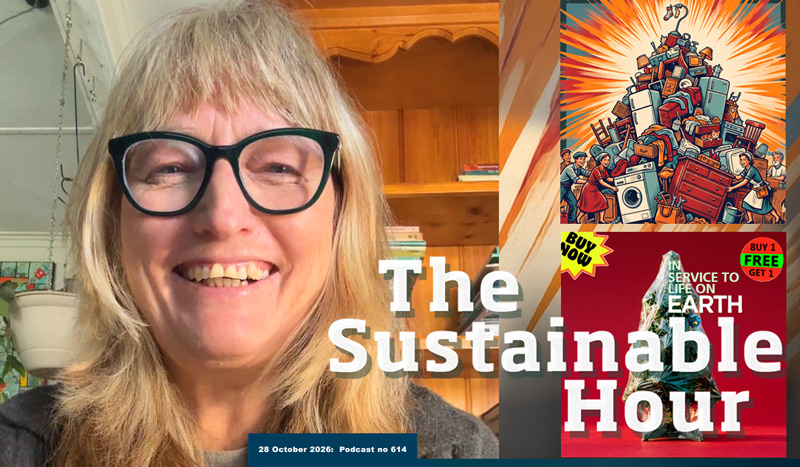
A perfectly good kitchen ripped out because its colour scheme has gone out of fashion. Furniture replaced long before it wears out. Homes overflowing with possessions, while the pressure to buy more never lets up. We have reached “peak stuff”. And buying our way out of it is going to be a challenge.
Our guest in The Sustainable Hour no. 614 is La Vergne Lehmann, otherwise known as the Garbage Queen. As Waste and Sustainability Coordinator at Yarriambiack Shire Council in western Victoria, she deals with the practical consequences of our throwaway culture. She has recently returned from almost two months of Churchill Fellowship research, exploring how communities overseas are putting circular economy principles into practice.
Her message reaches well beyond sorting the recycling. Keeping things in use can create local jobs, support families, revive useful skills and bring people together.
For rural communities, this matters particularly. Transporting recyclable materials over long distances is expensive. Sending everything to a nearby landfill can look like the cheapest option. The Victorian ‘Garbage Queen’ went looking for approaches that make better environmental and economic sense – and give communities a greater role in shaping the solutions.
La Vergne brings back examples with plenty of relevance for our own region:
• New Zealand – communities taking the initiative. In Wānaka, Wastebusters grew from residents organising recycling into an enterprise combining reuse, employment and community education. In Ōamaru, a steampunk festival demonstrates another possibility: turning discarded materials into costumes, inventions and a celebration of creativity.
• Japan – making the value of waste visible. In Kamikatsu, residents separate their waste into around 45 categories. Signs explain which materials generate income and which cost money to process. Sorting becomes more meaningful when people can see the consequences. Reuse, education and a hotel where guests experience waste reduction extend that thinking into everyday life.
• Scotland – giving good ideas the support to last. La Vergne highlights the importance of networks, training, mentoring and funding. In Glasgow, Merry-go-round combines secondhand children’s clothing and equipment with practical support for families. The value lies in both the things being passed on and the relationships being built around them.
• Sweden – making secondhand an ordinary shopping choice. In Eskilstuna, a shopping centre brings together businesses using secondhand goods and recovered materials. Even IKEA has a presence. Repair and reuse become visible, accessible and creative parts of the local economy.
• London – dealing with what we already have. Conversations with ReLondon sharpened La Vergne’s concern about “peak stuff”. New materials and technologies may offer future benefits, but we already have enormous quantities of plastic, furniture, clothing and household goods to deal with. That work needs attention now.
Across these examples, longevity matters. Successful projects need people, skills, viable finances and sustained support. A promising idea becomes much more useful when it can keep serving its community year after year.
La Vergne also reminds us that many of the practices we now describe as circular were familiar to earlier generations: mending clothes, repairing furniture, preserving food and looking after things so they lasted. Recovering those skills offers scope for creativity, connection and useful work.
→ Find out more about La Vergne’s Churchill Fellowship
. . .
Mik Aidt’s opening editorial places the conversation in a wider political context. Drawing on George Monbiot’s warning about concentrated wealth becoming concentrated political power, he challenges the interests driving climate misinformation. He also points to falling wholesale electricity prices as solar generation and battery storage expand.
Colin Mockett OAM’s global outlook visits sporting organisations in Japan and Britain that are reducing waste, changing energy use and involving their supporters in environmental action. He also explores the changing language around electric vehicle drivers and the risks posed by a strengthening El Niño alongside human-driven global heating.
. . .
NEW MUSIC
Our original music carries the consumption theme into the festive season. “Festival of Humbug” takes a satirical swipe at shopping-centre miracles, greenwashing and Christmas on credit, before finding something more valuable in a homemade card and another place at the table.

– A satirical Christmas song where cosy country collides with electronic rap to roast overconsumption and put people back at the heart of the celebration.
We also introduce “Peak Stuff”, a song inspired by La Vergne’s interview.
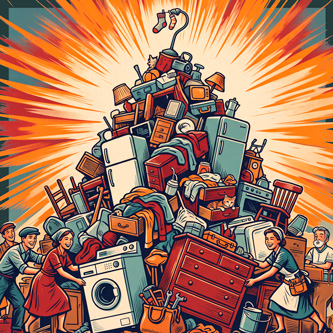
– A foot-stomping rebellion against throwaway culture, celebrating repair, reuse and the joy of making more of what we’ve got, together. Inspired by La Vergne Lehmann.
As Christmas approaches, this week’s conversation offers a practical invitation: make more of what we already have, bring our creativity to the task and do it together
“We’ve already got so much plastic. What do we do with what we’ve already got? It’s all very well to come up with solutions that in 10, 20, 30 years’ time are going to be fantastic. But in the meantime, we’ve got all this stuff to deal with already.”
~ La Vergne Lehmann, the Garbage Queen, in The Sustainable Hour no. 614

→ Subscribe to The Sustainable Hour podcast via Apple Podcasts or Spotify
. . . . . . . . . . . . . . . . . . . . . . . .

We at The Sustainable Hour would like to acknowledge the traditional custodians of the land on which we are broadcasting, the Wadawurrung People. We pay our respects to their elders – past, present, and emerging, and extend that respect to all First Nations people.
The traditional custodians lived in harmony with the land for millennia, nurturing it and thriving in often harsh conditions. Their connection to the land was deeply spiritual and sustainable. This land was invaded and stolen from them. It was never ceded. Today, it is increasingly clear that if we are to survive the climate emergency we face, we must learn from their land management practices and cultural wisdom.
True climate justice cannot be achieved until Australia’s First Nations people receive the justice they deserve. When we speak about the future, we must include respect for those yet to be born, the generations to come. As the old saying reminds us: “We do not inherit the Earth from our ancestors; we borrow it from our children.” It is deeply unfair that decisions to ignore the climate emergency are being made by those who won’t live to face the worst impacts, leaving future generations to bear the burden of their inaction.
“The Indigenous worldview has been marginalised for generations because it was seen as antiquated and unscientific and its ethics of respect for Mother Earth were in conflict with the industrial worldview. But now, in this time of climate change and massive loss of biodiversity, we understand that the Indigenous worldview is neither unscientific nor antiquated, but is, in fact, a source of wisdom that we urgently need.”
~ Robin Wall Kimmerer, weallcanada.org
. . . . . . . . . . . . . . . . . . . . . . . .
. . . . . . . . . . . . . . . . . . . . . . . .
UN: El Niño is a ‘wrecking ball’ threatening millions
An exceptionally strong El Niño could leave 50 million people facing increased hunger, the United Nations warns. UN aid chief Tom Fletcher calls it a “wrecking ball”, while World Meteorological Organization head Celeste Saulo says its strength could be unprecedented.
El Niño’s natural warming of the tropical Pacific shifts weather patterns worldwide, compounding the effects of human-caused climate change. The impacts and warnings span continents:
- Argentina: Floods have killed two people and forced more than 2,000 from their homes. In some areas, only rooftops remain above water.
- Peru: Forest fires have killed at least 12 people since June, mostly farmers trying to control the flames themselves.
- French Guiana: Drought has disrupted river transport, forcing authorities to airlift essential supplies to around 40,000 people in isolated communities.
- Somalia: Flooding could displace 874,000 people within three months. Yet the UN migration agency has received just 14.4 per cent of the US$16.6 million needed to prepare its response.
Scientists caution that individual disasters cannot be attributed solely to El Niño: it changes the likelihood of weather extremes, while other factors also shape each event. The UN is calling for urgent action to protect vulnerable communities.
“We cannot stop El Niño, but we can prevent many of its worst human consequences,” says Saulo.
Source: Ali Bekhtaoui, AFP, via Phys.org, 27 October 2026.
. . . . . . . . . . . . . . . . . . . . . . . .
. . . . . . . . . . . . . . . . . . . . . . . .
TRANSCRIPT
of The Sustainable Hour no. 614
António Guterres, United Nations Secretary-General: (00:00)
Humanity is speeding past the limit to avoid climate catastrophe.
Jingle: (00:14)
The Sustainable Hour. For a green, clean, sustainable Geelong: The Sustainable Hour.
Tony Gleeson: (00:24)
Welcome to The Sustainable Hour. We’d like to acknowledge that we’re broadcasting from the land of the Wadawurrung people. We pay tribute to their elders – past, present, and those that will earn that honour in the future. We’re broadcasting from stolen land, land that was never ceded, always was and always will be First Nations land. In nurturing both their land and their communities for millennia, they accumulated a great amount of ancient wisdom. Ancient wisdom that was born out of careful observation over time. And in that ancient wisdom lies a great amount of responses, solutions, as we face up to the climate crisis.
Mik Aidt:
There’s enough to worry about. Europe is preparing for war. AI is coming and it’s going to take all our jobs. Prices going up, house prices, food prices, while our wages aren’t going up. So those who are already rich keep getting richer and richer. While the rest of us, we are getting poorer – and angrier – by the day.
George Monbiot, Facebook video clip from DDN: (01:22)
The default state of centralised societies like ours is oligarchy. An oligarch is someone who turns their inordinate economic power into inordinate political power. It’s very rich people becoming very politically powerful. This is why billionaires love Trump. This is why billionaires and multimillionaires love Nigel Farage. It’s why they love Marine Le Pen. It’s why they love so many of the hard right and far right movements that are rising around the world because they deliver for them. They accelerate the transformation of democracies into oligarchies. That is where we are heading unless we produce massive counter movements.
Mik:
Says George Monbiot from United Kingdom in a video clip Double Down News put on Facebook. And he might as well also have mentioned Australia’s richest woman, Gina Rinehart, and her puppet in Australian politics. Because she’s certainly part of that story just as well. And the double down bad news here is that none of these people believe that we should do anything about this escalating climate emergency which we can see happening all the time with flooding and hurricanes and the rest of it. And they have no inhibitions, no problem with lying to us about that renewables are making our electricity bills go up while saying that we need more coal or gas. Which is obviously something that simply say to protect a business.
That’s so annoying because it’s so easy to fact check. Wholesale electricity prices here in Australia are down, not up, down 27 per cent compared to this time last year. That’s according to the Australian Energy Market Operator who are out with their quarterly report. We produce 30 per cent more [grid-scale] solar electricity now, here in Australia, than we did last year. That’s measured over a three-month period. And Australia now has more rooftop solar capacity than the capacity of all our remaining coal-fired power stations combined. We don’t need more coal. That’s rubbish!
And we are going to talk rubbish – exactly: rubbish! – today in The Sustainable Hour. But first, it’s time for a global outlook with our superb global news anchor Colin Mockett OAM – Colin, we’re always curious to find out what have you got for us today?
COLIN MOCKETT’S GLOBAL OUTLOOK
Yeah. Sometimes I am too, Mik! Our roundup this week begins in Tokyo, where there appears to be a concerted challenge to England’s forest green rovers for the title of the world’s most environmentally aware and carbon neutral sports teams. There are five Japanese teams that have adopted environmental and climate action initiatives with the front runners including three football teams, a basketball club and a whole national organisation. The soccer teams are FC Tokyo, which is currently second on the J-League’s football ladder, that’s their main ladder, which is committed to carbon neutrality, reduced waste and maximizing reuse and recycling across all of its club operations.
Then comes Kawasaki Frontale, which is seventh in the J-League, who were the first Japanese team to sign the Global Sports for Nature Framework, focusing on recycling, waste reduction, and using their fan supports to regularly clean the nearby areas including the Tamagawa River. Then comes Yokohama FC, which is fourth in the J-League’s Division II which has reduced its stadium waste to almost zero, and is a pioneer in Japanese eco sports, launching initiatives to offset CO2 emissions from all team travel and their away games. Then comes the basketball team, Nagoya Diamond Dolphins, which was the first professional Japanese basketball team.
To join the UN Climate Changes Sports for Climate Action Framework. But probably more significant would be the Japanese rugby football union. That’s the umbrella organisation, they’re equivalent to Rugby Australia, which was the first national rugby union globally to sign the UN Sports for Climate Action Framework, and is now adopting carbon reduction policies across all of its programs. So, Forest Green Rovers has got some rivalry happening in Japan.
Back here in Australia, where there are apparently a whole lot of new names for motorists who’ve switched to electric vehicles to beat high fuel costs. Their official name according to the Sydney Morning Herald style guide is ‘EV Converts’ or ‘Fuel price EV converts’, give them their full title, but on the streets they’re known as ‘ICEbreakers’, ICE being Internal Combustion Engine, or ‘e-changers’ referring to the sea change. Their e-change is not really behind it, they’re just doing it for the convenience. Some call them ‘economic environmentalists’ or ‘green meanies’. Or simply ‘drivers who have fled the bowser’. Either way they’re a significant segment of road users now, and you know when you’ve arrived in Australia when Aussies invent a new name for you.
But now to the world weather outlook where meteorologists are forecasting that this year 2026 will become the hottest year on record, beating twenty twenty four into second place with 2027 likely to be even hotter. The reason, of course, is the approaching El Niño effect, which is continuing to strengthen ahead of its forecast peak in December. Scientists are describing its effect when combined with global warming as unprecedented. Now that’s polite scientists talk for extraordinary or never seen before. It’s what we used to call freakish.
Anyway, El Niño is a natural weather phenomenon that’s been around for centuries. It was first recorded by Peruvian seamen in fifteen seventy eight. It develops in the Pacific Ocean and the atmosphere above it. Typically winds blow east to west, but when these winds weaken or reverse, warmer waters spread east across the central and eastern tropical Pacific. Now this frequently triggers global effects such as droughts, floods, and high temperatures. But now El Niño is happening alongside human-driven climate change, and it’s difficult to identify how much of the dangerous change is caused by each. Either way, together they make extreme weather much more intense.
Wildfires in Indonesia were predicted. They arrived and they were much worse than expected. And this year’s El Niño climate change combination has meteorologists predicting a worldwide knock on effect, with the UK likely to experience a much wetter autumn and winter, followed by a colder spring.
It’s certain to be a hot topic at the upcoming COP31 Climate Change Conference, which is about to begin on November the 9th in Turkey. There, global leaders will convene with the aim of delivering climate action. With the current El Nino global warming effects as a background, other strategies likely to be on the agenda alongside cutting CO2 emissions.
Some scientists have suggested planting more heat tolerant crops, supporting infrastructure development in the global south, and exploring geo-engineering options to alter clouds as possible, subjects for the COP, just as long as they don’t lose sight of the immediate aims of stopping the mass burning of fossil fuels.
Because a lot of those things that are being bought up at the moment are just diversionary tactics. And finally I began today in Tokyo with a number of sports clubs challenging Forest Green Rovers as the world’s most carbon neutral club. Just to recap, the rovers run on 100 per cent green energy. They use an organic pitch with rainwater harvesting and provide vegan snacks at its stadium.
But there are two challenging teams in the United Kingdom too. London Premier League Club Tottenham Hotspur is a challenger because of its new green stadium design, which uses only green energy. It has a flowering sedum green roof at the club’s training centre, a system to capture and reuse rainwater, and a complete elimination of single use plastics.
The difficulty is they’re bottom of the first division ladder at the moment, the Premier League, but they are turning very green. Then there’s the championship team, Bristol City. It’s becoming more and more sustainable by adopting measures for energy efficiency and waste reduction. The Ashton Gate Stadium generates 100,000 kilowatthours of electricity annually via its solar panels.
And this is paired with energy efficient lighting throughout the venue. The club sources at least half of its matchday food locally, offers extensive plant based menus, donates surplus food to homeless shelters, and handles organic waste by composting it on site. It also offers free or subsidised matchday travel for fans to cut traffic and vehicle emissions alongside local biodiversity projects like rewilding adjacent areas. And that small challenge to Australia’s sports teams ends our roundup for the week.
. . .
Jingle:
Listen to our Sustainable Hour – for the future.
Tony:
Thanks for that, Colin. Yeah, sports moving, it seems, which is we haven’t seen a whole lot of that in Australia yet, but there are groups when we’ve had groups on that represent Australian interests that are pushing for reduction of emissions and and just be more mindful of sustainability generally. So I’m sure that’ll change.
Colin:
Yeah, we have had sports people themselves coming on supporting sustainable living. But now it looks like clubs around the world, the clubs themselves are moving towards sustainability. In the same way as the the community is here in Australia. You know, we’re putting panels on our roofs, we’ve been doing it for decades. and we’re adopting other methods for sustainable living. It’s only now that around the world sports clubs are getting onto the bandwagon and ours are a bit slow joining in.
Tony:
Yeah. And I think members are appreciating that the club members of the sporting teams are pressuring the administration to to go down that pathway as well for all the reasons that we harp on about week after week after week.
Colin:
Yep, it’s nice, isn’t it?
Tony:
Yes, it is.
Mik:
Another area that we have talked about year after year after year when it comes to November and then December is of course the festival of… of what? The Festival of Humbug!
Tony and Colin:
Yeah. Yes.
Mik:
Because how do we go through that time without becoming massive consumers and following this overspending… like, it begins now, with Black Friday and all the businesses pretending to be selling us happiness and very often Christmas ends up being not a very happy place. So this year, now with less than two months to Christmas, we’ve produced a song here at The Sustainable Hour, and that song changes the agenda. It’s about less stuff, it’s about more life, and it’s about having room for one more, maybe a neighbour, at the table this Christmas.
—–
SONG 1 (15:40)
‘Festival of Humbug’
Verse 1:
There’s a star above the shopping centre
and a queue around the block
We’re all waiting for a miracle
They’ve just put it back in stock
Mum is sweating in the kitchen
Dad’s still hanging up the lights
Someone’s bought a singing reindeer
No one gets a silent night
Chorus:
Welcome to the Festival of Humbug
hang your plastic on a tree
Put the planet on the credit card
The delivery is free
More – bigger – better!
We just can’t get enough
It’s the Festival of Humbug
It’s the Festival of Stuff
Verse 2:
Buy, baby, buy! – let the barcode sing
all major cards for the newborn king
Gold for the shareholders, debt for the rest
It’s the season where we monetise stress
Two-for-one joy in a shrink-wrapped pack
buy now, pay later, send half of it back
“Free delivery!” You like the phrase?
The price disappears. The pollution stays
Burn, baby, burn! – Santa’s out fracking
but look at that price! So cheap it’s cracking!
Uncle Bob says, “Climate’s a hoax.”
Someone passes him a beer to shut up
Then he turns the air-con lower:
“Bloody hot for this time of year!”
Bridge:
This Christmas, shop our sustainable collection
Greener wrapping and gadgets you can offset
Verse 3:
Green on the ribbon, green on the van
green on the logo. Such a beautiful plan
The planet’s on fire, but the plastic tree’s blinking
Your bin – your fault. It’s our record this year
Thank you for shopping. See you back here!
One more year of turnover growth
One little planet. Good luck with both!
Verse 4:
Wheelie bin is bulging
Kids have gone outside
I find the card my daughter made
and put the gifts aside.
My neighbour’s got the telly on
He’s eating on his own
We’ve got food enough for twenty
I stop scrolling on my phone
Final chorus:
Pull up another chair
We don’t need a bigger Christmas
We need everybody there
Bring a plate and ring your neighbour
Bring in more of yourself
Leave that commodity on the shelf
Stop all the moving parts
And welcome to the Festival of Hearts
Voice:
Would you like a bag?
Welcome to the Festival of Hearts
—-
Colin:
Love it, Mik. Great. Let’s let’s thrash it to death before Christmas.
Tony:
Our guest today is La Vergne Lehmann. La Vergne is the garbage queen and she’s just returned from a Churchill Fellowship Tour, which is part of her Churchill studies. Her job title at Yarriambiack Shire Council is Waste and Sustainability Coordinator. So La Vergne, welcome to The Sustainable Hour. You spent
La Vergne Lehmann (19:08)
Thank you!
Tony:
A month or so traveling around or many places in the world looking at garbage. Is…
La Vergne:
And and talking a lot of rubbish yes.
Tony: No, I doubt the second part of it. Maybe explain what the Churchill Fellowship is that you… The scholarship that you received to to do that?
La Vergne:
Not a problem. So it’s a fellowship rather than a scholarship. So they always like us to correct people on that one. But the the Churchill Fellowship’s been around for about sixty years and every year they offer Australians of all walks of life the opportunity to go and look at things in other parts of the world about things that matter to them. So I guess it’s your passion project in many ways.
So for some people it it might be about domestic violence or other people it’s about disability and sports and things like that. The the the subjects are are limitless. The process is… you obviously have to apply. You are then interviewed once or twice depending on where you are and they make a decision on whether you’re whether you’ve convinced them that what you’ve got to look at is is of is worth worthwhile doing. I was very fortunate and last year when I applied I’ve only applied for the the first time last year and they they thought that my my project which was looking at you know how we embed circular economy principles in rural and regional areas of Australia.
I live in Western Victoria and I’ve lived here for about 26 years. A good deal of that time I spent working in waste and recycling and sustainability kind of roles. and I’ve worked with a lot of different local government areas. So I’ve worked in state government agencies where I’ve worked with local government and I now work in local government. And it’s local government that frankly does the the heavy lifting in terms of waste and recycling. So it’s also important to understand that one of the problems that we have in rural areas in particular, so the the council I work for, the biggest town’s around about three thousand people. That’s Warracknabeal. The challenge is always how to do this in a cost effective and efficient manner.
And, you know, we have to transport all our recycling into Melbourne any other processing that needs to be done is done the same way. We are fortunate we do have a landfill nearby and frankly, if it was just on the basis of cost, that’s all you would take it to, which is not the right way to look at these things, obviously. But you know, in terms of circular economy, I was I was keen to look at what other parts of the world are doing. You know, where where is there something we can learn and and, you know, being I guess, I have travelled a fair bit and I’ve had the opportunity to go and visit quite a few places and speak at conferences internationally over the years.
So I’ve I’ve got a good understanding of what may be happening elsewhere. But it was this was an opportunity for nearly two months to go and have a look at other places. So I started off in New Zealand. So I should say the countries I visited were New Zealand, Japan, Sweden, Scotland, Wales, and then I finished off in London, which is not obviously a rural area but is it’s got an interesting dynamic in that it has a lot of small individual community spaces there, which is also very interesting to look at.
So I’ll go back to New Zealand to start off with because that was my first port of call and the place I visited first was Wanaka, probably best known for the the air show it puts on there every year.
But it also has the most amazing group of people, an organisation called Wānaka Wastebusters, and they’ve been around for around about thirty years or close to 30 years. And they started when Wānaka was a town of only around about 3,000-4,000 people. It’s now a town of 14,000 people. It’s grown through mostly tourism, being very close to Queenstown. So it’s also an area where a lot of I guess more wealthy people have built quite beautiful homes and expensive homes. But its principal reason for its growth has been the the skiing that is found nearby, at Cardrona and areas like that.
But what they did 26 years ago was a group of them decided that they wanted to get recycling done, kerbside recycling done, because the council, local council wasn’t doing it at the time. And they got that going, and then they started doing more things in that space and they developed a site where they had this most amazing reuse shop. they do composting on that site as well.
They’re co-located with the local transfer station there that the council runs. But what they’ve done is this is all through community and they employ up to around about fifty people now and turn over around about three million dollars a year through what they make out of their reuse shop and and how they’re able to continue doing recycling for business, local businesses.
The recycling contract they originally had with the local council no longer exists. It’s gone to one of the more traditional waste businesses. But they still now work closely with the council to help educate people. They run a range of sustainability events around slow fashion, dealing with food waste, and a whole a whole lot of different things that they work with their local community to improve what they are able to achieve.
And they were one of the forerunners in New Zealand in this space where the community really took charge of a lot of those more specialised areas of waste and recycling and and what we now look upon as circular economy activities when the local council couldn’t and wouldn’t do it. And I think that one thing is worthwhile remembering is New Zealand councils are not obliged in the same way as most Australian councils are to actually undertake curbside recycling and and waste.
So that’s that’s one of the principal differences that we see from from what happens in New Zealand. So that that means that you know some councils don’t provide that service at all. some do, some provide a limited service. So the councils rely on these kind of community groups to be far more involved in actually participating in that circular economy kind of focus than they would otherwise have been.
So from there I also was able to visit further up north a town called Ōamaru where they have a most amazing festival called the it’s a steampunk festival, which if you know anything about steampunk and you may not, it’s a very Victorian concept. It’s about how you look at the future if you were a Victorian and what it would look like.
So it’s a lot of steam and it’s a lot of beautiful gadgetry and and amazing costumes, Victorian costumes. And it’s really about creative reuse of things that we already have. And in the case of Ōamaru, it’s a very beautiful Victorian town on the on the east coast of New Zealand. And they they have this festival every year and they’ve again they’ve done this for about 20 years and this is one of the things I did learn is th throughout all of these places is that the longevity of these these activities really matters. And how you make them sustainable over a long period.
And that’s one of the things that was really interesting to me is, you know, how do you make sure these things are sustainable and can keep going. And that was certainly the case in Ōamaru with their festival. They also had – again, they had a similar centre, to the one in Wānaka, not as well developed.
But again, they I talked to a lot of their customers there and they were quite happy to bring in their recycling and they didn’t rely on curbside services. They had a dial up service if they wanted one, but and they paid for it as they needed it. Which when you think about it is in Australia we have in many p many cases a weekly curbside service.
Now, I don’t know about anyone else, but I do not need a weekly curbside service, but I do know there are a lot of people that do and this approach means that the user pays, whereas in the way we do it is that I pay for a weekly service whether I have it or not.
So in some of the councils there, it really is about how do you reward those people who are not producing as much waste, but at the same time ensuring that those people that do need the service actually get the service still. So I think that’s an important factor in all of this and again, you know, there were lots of opportunities for reuse, for upcycling, for remaking, all those sorts of things that circular economy is is really important as in. And most importantly, it’s done locally. And that’s one of the things… That was one of the other things that was of most interest to me is: Now, how do we do things and make it local and how do we engage our communities to be involved in this? And again, this longevity factor comes in.
From there I went up to Auckland and was able to talk to the head of Zero Waste New Zealand and she was able to sort of talk about how different New Zealand is and and why some of these these community groups initially and they’re now called community organisations have started and have continued growing over the years and some of them are only just coming online now.
So there’s a lot of those communities there. From there I went up to Japan and Japan was really different. One of the reasons why I wanted to go to Japan was that there’s this amazing little town called Kamikatsu in Kyushu [in Tokushima Prefecture on Shikoku] and it’s a town of about 1,500 people, which is similar to the size of town I live in in Dimboola. But it’s built on the side of a hill. So it’s you know a lot of a lot of slopes in it. So whereas Dimboola’s very flat.
But again going back nearly 20 years ago, this was a town that decided it wanted to be a zero waste town. [The town’s zero-waste declaration dates from 2003]. They did have an incinerator. A lot of countries like Japan and the Scandinavian countries do a lot of incineration rather than landfilling for good reason. They don’t have the land. And they can also use the energy output from incineration to help keep them warm in winter. But it wasn’t very efficient and people didn’t like it.
It’s a beautiful area. It’s a lot of forestry going on there, so it’s very green, it’s very lush and it was they felt that it was too expensive to bring in the the new generation of incinerators in the area.
So what they did was they built this amazing place called the Kamikatsu Zero Waste Centre. And they’ve also built a hotel there. The actual centre was built about seven or eight years ago now [and opened in 2020]. But everyone just brings their stuff in there, they sorted out their recycling into about 45 different categories.
And one of the most interesting things they did there was they had a sign above each category which told people how much it was either costing them or they were being charged. So there are some materials in recycling that are that you you make money on. So anything in metal you generally make money on. But plastics, you don’t. It costs more money.
So what they’re able to do is negate by separating at the source of where the the waste is actually generated, in from the consumer perspective at least, they’re able to maximise the income that they get from their recycling while at the same time reducing the costs associated with it. But it was about letting people know what all that was about.
So that was a really interesting factor. They do a lot of education there. They had this amazing hotel that I was able to stay at where, you know, they get people to sort their waste out in their room. They have a zero waste breakfast where you you make up your own noodles and there’s no waste associated with it because everything is separated out into little little jars and things like that. They have a business centre where people can do some sustainability practices. They have some a reuse centre. Again they weigh what they divert from waste so they can they can account for the amount of diversion in volume, but also the the greenhouse gas emissions that don’t are well aren’t emitted because they’re not going into a landfill.
And again, that was an example of something that’s been around for a long time and continued to evolve. And they are really in Japan the poster child for this sort of stuff. while I was there, I also had the opportunity to go to Kyoto and another city called Kameoka, where they have a circular economy centre in Kameoka. And that was again about how to look at what circular economy can do for them locally.
And they were doing a lot of different activities and working with businesses to reduce not only reduce their waste, but also look at what they could do with those with with waste items and create new products out of them. And also generating new businesses or renewing traditional businesses like indigo dyeing, which anyone that’s got a pair of jeans knows, that’s where they started. But of course the the traditional processes have long since gone from that and most of our jeans are made in an entirely different way. But I met a couple of people there who were looking at the Edo period in Japan, which is a couple of hundred years ago now, and one of the things that came out of my conversation with them, they’ve they’ve coined this word edonymy, which is edo economy.
And they’ve been looking at it from a circular economy perspective and they realised that that back in that period, they did have a circular economy. And it suddenly struck me at the same time is that up until probably fifty years ago, so did we. We didn’t waste things, we mended things, we used all the things, you know, if you had fruit trees out the back, you preserved. you didn’t throw things away. We didn’t even have a curbside recycling service in most places until about 50 or 60 years ago.
So of course we had a circular economy. Most of us of a certain age will remember, well, we now do have container deposit schemes in all states, but we had them in the early seventies as well, and we got rid of them under pressure from the packaging companies. So we had all these things, we had all those skills. We’ve just lost them in about two generations, two or three generations. So I think it’s worthwhile remembering, and this is something I got out of Japan, was we actually did have circular economy and we’re not reinventing well, in fact we are reinventing the wheel. We are reinventing circular economies.
Colin:
I have to say that you are radio gold. I mean, we just sort of put you on and then we sit back because everything you say is really interesting. But can I ask you what were the ideas that you brought back from Japan that were useful in Western Victoria? Which was the country that you bought the most ideas back from?
La Vergne: (36:07)
Look, I think I’ll skip over to Scotland for that one. Because Scotland has a really high level Circular Economy Act, but they have underneath it they have the structures in place. Now they’re not perfect and they would be the first to admit it as well. And Scotland is very much a rural regional kind of country. I mean they’re even their cities are not that big. So when you go out to the rural areas, which is not hard to do.
They have an organisation called Zero Waste Scotland, which is an independent government agency. But underneath that they have an organisation called Circular Communities Scotland. And what they’ve done over about the last 10 or 15 years there is develop a range of programs that will help communities move to a circular economy style of way of dealing with with waste and upcycling, recycling, remaking, whatever. And they’ve provided funding, seed funding for things. They provide a lot of training. They provide a lot of mentoring as well. So, you know, there are there are some towns that have done amazing things with their reuse centres. They’ve you know, they’ve got their repair cafes, they do a lot of repairing in the in the tech area with computers.
I went to one place called Merry-Go-Round, which if you walked into would look like any normal children and baby clothing wear shop. It’s in Glasgow. But it was started about twelve years ago by another Churchill fellow there. But she started it because when she had a child, she realised that there was, you know, you you only put babies in s in clothing for a few months, and then they’ve grown out of it. You’ve got to, you know, unless you’ve got family to pass it on to, where do you take it? Sure, there are charity shops, op shops and things like that.
But in this case it was really about, well, how do we do this within our community and make it really worthwhile? And they’ve created this most amazing supportive space for families, young families, where not only can they you know get cheaper items because they’ve been used a little bit but, you know, not used an awful lot and it’s a lot cheaper for them.
They get a lot of you know assistance and help and training and they run courses and things for them. And you know, the community really loves it and has embraced it, because it’s such a valuable service and and covers so much area that you know other agencies cannot cover. So a lot of these things around circular economy, I mean the economy part of it is only part of it. It’s around about community as well. And how do we how do we bring our community together and how do we support our communities and different people in our communities to do better.
One the other things I noticed there was that charity shops or or op shops as we see them, even though they are supporting important charities, and that shouldn’t be forgotten, but they also focus on the fact that they’re encouraging you to give things a second life, that it’s upcycling, it’s you know, let’s slow down, you know, let’s take away from fast fashion and have slow fashion.
So there’s messaging around circular economy is is embedded into that area and I don’t think we quite do that as well here as yet.
Colin: (39:51)
Now, getting back, if we can, to Glasgow and the shop which essentially recycles short term used baby products that’s always a problem here. We have we have a system in Geelong where where I am, where people just put stuff on the side of the road if they don’t want it anymore. And something that really turns up again and again and again are are car seats, children’s car seats. They basically just thrown away. Now I want to know how the Scots got this into a community service. Once you don’t need your car seat anymore because your child sits on the seat, presumably, do you sell it to the a community op shop affair? Or do you donate it? And then how does the how does the community centre or the shop itself cope with the fact that they’ve got too many of one thing rather than other. I mean, how is it actually working? Is there a monetary value put on everything? Or is it the same as an op shop, things are just donated and then they’re sold at low prices to others who need it?
La Vergne:
Yeah, look, it’s a bit of all of that. I guess one of the things is that when you’re dealing with things like car seats, you have to be really careful around the safety issues. So anything like that has to be closely checked and and main you know, for maintenance and that it’s still a safe item. [Editor’s note: Merry-go-round’s published donation policy explicitly excludes car seats in any condition.]
They’ve also worked really closely with their community around so people bring the stuff in to give away, ’cause most people really just want to get it out of their house. They do have a separate warehouse area where they sort through things, things are cleaned and washed and and and sorted that way. They they actually were to some degree a victim of their own success and they actually grew a bit too quickly, so they actually had to scale back a little bit so that they could reset what they were doing because they had too much happening. And they were quite honest and upfront about that, that you don’t get everything right all the time.
But they’ve worked very hard with their community to get people to understand this is the condition we want things brought in, this is what we will accept. And so that they’re not getting things now that they don’t want. I mean, that’s always the challenge for op shops, as we know. They get bags of stuff that that frankly is just a lot of which has just got to go to landfill. And people need to understand that that all costs money and it costs those charities money too. So this is this is a slightly different model. It’s a smaller scale model.
Rather than you know, we see in this country mostly larger scale op shop networks where they share a lot of that stuff and it’s it is big business these days, without doubt. But they they’ve managed to focus on a very specialised area where they can work much more closely with their community, understand what that community wants and needs.
Mik:
Did you also look at sort of new developments? Because I have seen here and there talk about that we don’t actually need to produce all this plastic that we do. And you mentioned plastic as being a problem that actually costs money to get rid of and so on. But what if we didn’t even produce plastic? What if we used seaweed or or something else that could be like plastic but afterwards it would just disintegrate into nature? Did you have a chance to see anything like that?
La Vergne:
I didn’t really look at that and I’ll tell you why. One of the things that really interested me, and this came out of where I when I was in London, there’s an organisation there called ReLondon, which is an organisation that has been promoted by the Mayor of London. and it’s been around for about 10-12 years, I think, and it covers all the different boroughs of London.
But one of the things they identified is that we were already at “peak stuff”. In other words, we’ve got so much stuff. And we all, I think… we could all walk around our homes and go: ‘Yep, I’m at peak stuff’. I know I am. And most homes are in Western countries.
So the problem is, is and this is I guess what concerns me about how we look at circular economy at a government level, is that they’re looking into the future.
They’re looking at exactly the sorts of things you’re talking about there. You know, how do we replace plastic with things that are more sustainable and can break down and so forth? But we’ve already got so much plastic. What do we do with what we’ve already got? so it’s all very well to come up with solutions that in 10, 20, 30 years’ time are going to be fantastic. But in the meantime, we’ve got all this stuff to deal with already.
And I’m kind of interested in, well, how do we deal with the here and now as opposed to the ten, fifteen, twenty year time frames? Because we n we really need to be starting to sort this stuff out now, what we’ve already got. We’re already probably 20-25 years behind the eight ball on actually dealing with, you know, we’ve gone through this mass consumerism over the last three or four decades, or whatever, where we’ve all got things, you know. I I mean I remember I mean a lot of us will remember if we’re old enough, you know, when you bought a fridge, you bought a fridge and you had it for 25 years.
Now if you buy a fridge you’re lucky for have it five years. you buy a sofa, I mean my grandparents had a sofa that was there for forty years. They didn’t change it. They didn’t have to. It was well built, it cleaned easily and they looked after it. Now you’re changing sofas every three or four years. It’s the way we’ve we’ve viewed what we have is quite different. Of course the consequence of that is the waste that gets produced from it.
So you get things and we look at it and go, ‘Well, that’s perfectly good still,’ but nobody wants it because we watch certain home pro home decor programs on TV and go: ‘Right, we haven’t redone our kitchen in three years, we need to redo it again. So we’re gonna pull out a perfectly good kitchen and put something that’s more updated because the colour scheme’s not right anymore.’
We’re constantly pushed into to updating, renewing without thinking that what we’re creating is this huge problem of peak stuff. And that’s where I come in and look at… well, how do we deal with that and how do we encourage people to do things different?
—–
NEW SONG
‘Peak Stuff’
Verse 1:
The kitchen’s only three years old
But look, they’ve changed the style
Apparently we’re trapped now
with an outdated kind of tyles
The doors still shut, the drawers slide
And everything’s in place
So when experts say: “It’s time to shift”
I say: “Yeah Nah – leave it as it is!”
Chorus:
Peak stuff! Got enough!
Rethink, reduce, reuse
Peak stuff! Call the bluff!
Repair, recycle, refuse
Peak stuff! Make more of what we’ve got!
Verse 2:
Grandma’s kept her sofa
For 40 years or more
She refuses any talk of changing it
That’s what she calls: “Rubbish talk!”
Spoken:
“Buy more! Live better!”
“A new season! A new you!”
“Anyone got a screwdriver?”
“Now you’re talking!”
Chorus:
Peak stuff! Got enough!
Rethink, reduce, reuse
Peak stuff! Call the bluff!
Repair, recycle, refuse
Peak stuff! Make more of what we’ve got!
Verse 3:
There’s a kettle at the town hall
There’s a neighbour with a drill
Someone’s mending an old jacket
Someone’s passing on a skill
Turn the curtains into cushions
Pass the baby clothes along
We’re fixing more than furniture
We’ve found where we belong
Final chorus:
Peak stuff! Got enough!
Rethink, reduce, reuse
Peak stuff! Call the bluff!
Repair, recycle, refuse
Peak stuff! Make more of what we’ve got!
Let’s make more of what we’ve got!
—–
Tony: (47:35)
We’re listening to La Vergne Lehmann at the moment – as well as being the Garbage Queen. La Vergne has just returned from a Churchill fellowship in which she investigated the circular economy or the approach that different countries or parts of countries use to the circular economy. So La Vergne, maybe if you could… Could just sum up at the moment, what what do you take homes from that almost two months that you spent travelling around?
La Vergne:
Okay, so I think the key things and look there is a report that’ll be coming out in the next I think week or so on the Churchill Trust website. I’ll be sharing it across my social media when it’s produced, but it’s around about 20,000 words, so but there is an executive summary for those that wanna get the short version.
Look, I think being able to network organisations so that they can learn off of each other. There was a big emphasis on training certainly in New Zealand and Scotland. Working closer with our communities, I think in rural and regional areas we can certainly do that, but it’s around you know, how do we normalise buying secondhand or using secondhand or making do or recreating, you know, bringing out that creativity and things.
One of the places I saw in Sweden in a town called Eskilstuna was a shopping mall made up entirely of upcycling, recycling. All the businesses in there are using secondhand materials that the local people bring in, and they go through it first before it goes to the transfer station to get disposed of. So they’ve normalised that whole idea that you don’t have to buy new all the time and that it’s a far more creative and interesting process if you’ve got individual items and even IKEA has a shop in there.
So I think there’s certainly some hope and some really good things going on elsewhere in the world that we can certainly learn from. And you know, I hope that’s what my report will be, you know, telling people.
Tony:
La Vergne, do you have any responsibilities through the fellowship? Like, when you come back, what suppose what what do they demand of you?
La Vergne:
Well, apart from writing the report, I mean obviously I make some recommendations and one of the things that I’ll be, you know, looking at is how can I action those things ’cause what they want to see is some action out of all of this. Sure. And some things are easier to action than others, obviously. But you know, I’m talking to a lot of local groups, obviously doing programs like this to get it out there.
I’ve done some radio news, you know, some of my local newspapers have interviewed me and done quite decent spreads on this. I’ll be talking at a number of conferences. I’m actually going back to New Zealand to talk about the food aspect of all of this in November. And I hope to do a number of other conferences and things next year as well. And what I wanna look at doing is starting to action myself some of the things that I’ve recommended in terms of guides and how to’s and and you know, talking to groups that, you know, if they wanna make a start on these things, this is how we can do it and I’m here to help.
Mik: (51:03)
That will be how much rubbish talk we could fit in one Sustainable Hour. Thank you very much to La Vergne Lehmann. And we will definitely put links and keep updating the links on the notes page that we put out on climatesafety.info each week after our show. What do you think we should be?
La Vergne:
I think we should be creative. And and by that I mean: let’s think outside the square. Let’s look at how we can do things differently, but at the same time do them together and be interesting about it. Not be bad’ish.
Mik:
And be creative.
Colin:
Yeah.
—
SONG
4th verse of Festival of Humbug:
Wheelie bin is bulging
Kids have gone outside
I find the card my daughter made
and put the gifts aside.
My neighbour’s got the telly on
He’s eating on his own
We’ve got food enough for twenty
I stop scrolling on my phone
Final chorus:
Pull up another chair
We don’t need a bigger Christmas
We need everybody there
Bring a plate and ring your neighbour
Bring in more of yourself
Leave that commodity on the shelf
Stop all the moving parts
And welcome to the Festival of Hearts
. . . . . . . . . . . . . . . . . . . . . . . .
CALENDARS
Events we have talked about in The Sustainable Hour
Events in Victoria
The following is a collation of Victorian climate change events, activities, seminars, exhibitions, meetings and protests. Most are free, many ask for RSVP (which lets the organising group know how many to expect), some ask for donations to cover expenses, and a few require registration and fees. This calendar is provided as a free service by volunteers of the Victorian Climate Action Network. Information is as accurate as possible, but changes may occur.
PETITIONS AND OPEN LETTERS
you could add your name to
→ List of running petitions where we encourage you to add your name
. . . . . . . . . . . . . . . . . . . . . . . .
THE SUSTAINABLE HOUR ON AIR
LIVE STREAMING
on Wednesdays
The Sustainable Hour is streamed live on the Internet and broadcasted on FM airwaves 94.7FM in the Geelong region every Wednesday from 11am to 12pm (Melbourne time).
→ To listen to the program on your computer or phone, go to www.947thepulse.com where you then click on ‘Listen’ on the top right of the page.
. . . . . . . . . . . . . . . . . . . . . . . .
ARCHIVE
Over 600 hours of sustainable podcast episodes
Listen to all of The Sustainable Hour radio shows as well as our special Regenerative Hours, Climate Revolution and Force of Life episodes in full length.
→ Archive on climatesafety.info – with additional links
→ Archive on podcasts.apple.com – phone friendly archive
NEWSLETTER
Receive our podcast newsletter in your mailbox
We send a newsletter out approximately four to six times a year. Email address and surname is mandatory – all other fields are optional. You can unsubscribe at any time.
FOLLOW, INTERACT AND SHARE
The Sustainable Hour in social media
• Facebook: www.facebook.com/TheSustainableHour → Front covers
• Instagram: www.instagram.com/TheSustainableHour
• Blue Sky: www.bsky.app/profile/thesustainablehour.bsky.social
• Twitter: www.twitter.com/SustainableHour
(NB: we stopped using X/Twitter after it was hijacked-acquired by climate deniers)
• YouTube: www.youtube.com/c/thesustainablehour
Great if you’ll share the news about this podcast episode on your social media platforms!