Podcast: Download (Duration: 55:24 — 50.9MB)
Subscribe: Apple Podcasts | Spotify | Android | RSS | More
The Sustainable Hour no. 617 | Transcript | Podcast notes
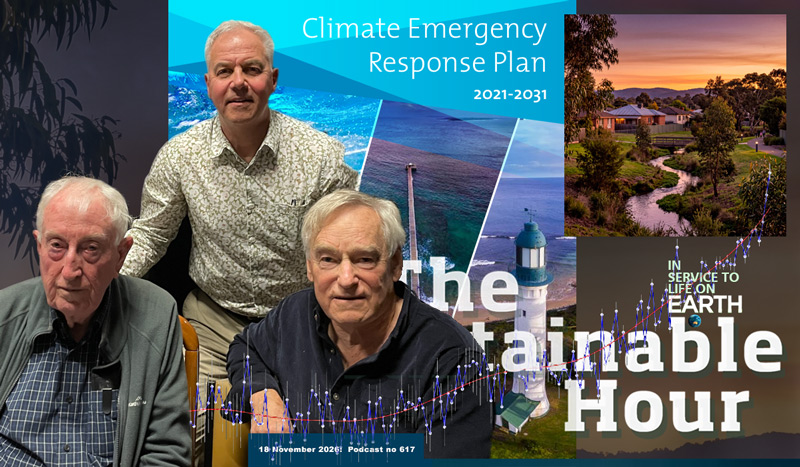
In 2021, the Borough of Queenscliffe and its residents set a deadline – net zero across the community by 2031. Council is now using a five-year review of its Climate Emergency Response Plan (CERP) to develop a new strategy. The 2031 target is still in place, and residents want it carried over.
In The Sustainable Hour no. 617, Mik Aidt and Tony Gleeson take us to Point Lonsdale Primary School, where around 50 people gathered on 14 November to make the case for keeping the plan. Council has held a listening post and two roundtables, and says the wider community can comment when the draft strategy goes on public exhibition.
• Climatologist Neil Plummer, chair of Geelong Sustainability, explains why the original plan stood out – it spelled out who would do the work and what it would cost. He connects climate action to the cost of living, from the price of rebuilding after a bushfire to the struggle to find affordable insurance.
• David Myer of Queenscliffe Climate Action Now says the October roundtables focused on five themes for a new strategy and passed over the eight pillars of the existing plan. He points to a neighbourhood battery planned for the Monahan Centre and talks about getting rooftop solar to more households, including people in flats.
• Nobel laureate Peter Doherty has been keeping an eye on the dunes at Point Lonsdale and Queenscliff’s dog beach. At the dog beach, those dunes protect a low spit of land. He asks what rising seas will mean for stretches of coast like this, and how we build for that future.
. . .
We open with the 34 Australians still unaccounted for after August’s floods and landslides on the Nepal–Tibet border, and clean technology consultant Wayne Smith’s call for a plan to phase out coal and gas – at home and in Australia’s exports.
. . .
Colin Mockett OAM rounds up the first week of COP31 in Antalya – António Guterres’ call for a faster shift away from fossil fuels, Anthony Albanese’s pitch to investors and the presence of fossil fuel interests at the talks. International call-ups give Forest Green Rovers the weekend off.
Nadine Joy and the Tides of Welcome Choir open the meeting. We close the hour with a call to stay hopeful, connected and active, and with ‘What Does This Place Need?’ – our new song about looking after a creek and staying long enough to hear the frogs:
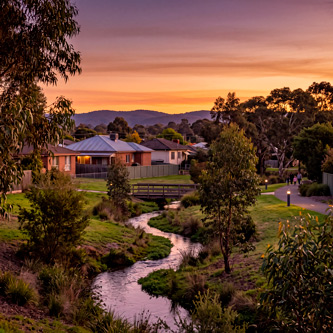
What Does This Place Need | Lyrics
– About community resilience in an age of climate disruptions. Three generations learn to listen to and care for Country along the banks of a suburban creek.
“We’re all going to be looking for models of groups that have tried to tackle this issue and come up with possible strategies and solutions. So I think it’s a real plus for Queenscliff. Would be a great mistake to back off on it.”
~ Peter Doherty, Nobel laureate and immunologist

→ Subscribe to The Sustainable Hour podcast via Apple Podcasts or Spotify
. . . . . . . . . . . . . . . . . . . . . . . .

We at The Sustainable Hour would like to acknowledge the traditional custodians of the land on which we are broadcasting, the Wadawurrung People. We pay our respects to their elders – past, present, and emerging, and extend that respect to all First Nations people.
The traditional custodians lived in harmony with the land for millennia, nurturing it and thriving in often harsh conditions. Their connection to the land was deeply spiritual and sustainable. This land was invaded and stolen from them. It was never ceded. Today, it is increasingly clear that if we are to survive the climate emergency we face, we must learn from their land management practices and cultural wisdom.
True climate justice cannot be achieved until Australia’s First Nations people receive the justice they deserve. When we speak about the future, we must include respect for those yet to be born, the generations to come. As the old saying reminds us: “We do not inherit the Earth from our ancestors; we borrow it from our children.” It is deeply unfair that decisions to ignore the climate emergency are being made by those who won’t live to face the worst impacts, leaving future generations to bear the burden of their inaction.
“The Indigenous worldview has been marginalised for generations because it was seen as antiquated and unscientific and its ethics of respect for Mother Earth were in conflict with the industrial worldview. But now, in this time of climate change and massive loss of biodiversity, we understand that the Indigenous worldview is neither unscientific nor antiquated, but is, in fact, a source of wisdom that we urgently need.”
~ Robin Wall Kimmerer, weallcanada.org
. . . . . . . . . . . . . . . . . . . . . . . .
“I think we need to call that out the fact that this crisis is not just being pushed by the fossil fuel industry, it is also being pushed by colonisation and militarisation and the patriarchy. And I think if we’re not defining these factors, then then we’re just tiptoeing around the problem.”
~ Litiana Lagibalavu, the Climate and Health Alliance
“1.5°C equates to key tipping points such as the loss of the Greenland Ice Sheet that, once crossed, won’t reverse on any human timescale. 1.5°C isn’t a slogan. It’s a set of one-way doors to a different world. And now it’s shut behind us.”
~ Professor Bill McGuire, climate scientist
#FOTW Daily Post 19 1.5°C equates to key tipping points such as the loss of the Greenland Ice Sheet that, once crossed, won't reverse on any human timescale. 1.5°C isn't a slogan. It's a set of one-way doors to a different world And it's now shut behind us Pls share + tag 2 #FateOfTheWorld
— Prof Bill McGuire (@profbillmcguire.bsky.social) October 22, 2026 at 9:39 PM
[image or embed]
“Preparing for an emergency is not just material, it’s relational. As well as ensuring we have a stock of essential items, we need to build and nourish community relationships and networks for a resilient response.”
~ Inner Climate Response Alliance
The super El Niño is more than a climate shock – it’s a health one, too
In a commentary published this week, Eoin McLaughlin, a professor at Heriot-Watt University in Edinburgh, and Matthias Beck, a professor at University College Cork, warn that the developing 2026–27 El Niño could be among the strongest in more than a century, with consequences extending well beyond extreme weather.
Their article, “The super El Niño is more than a climate shock – it’s a health one, too,” highlights the interconnected threats posed by food shortages and disease outbreaks, arguing that these challenges must be addressed together rather than treated as separate emergencies.
El Niño is a recurring climate phenomenon associated with unusually warm ocean temperatures in the tropical Pacific. It can disrupt weather patterns across the globe, contributing to droughts, flooding and extreme temperatures in different regions.
The researchers highlight the importance of recognizing the wider human consequences of major climate events, particularly for populations already vulnerable to food insecurity and inadequate health care.
The researchers’ central warning is that the consequences of extreme weather cannot be considered in isolation. Food insecurity and disease outbreaks can place overlapping pressures on vulnerable populations and already stretched health systems.
McLaughlin, professor of economics and head of research in the Department of Accountancy, Economics, and Finance in the Edinburgh Business School at Heriot-Watt University, said, “El Niño is a naturally occurring climate phenomenon that can be monitored and forecast months in advance. Countries have developed ways to adjust to El Niños, but when a very strong El Niño occurs, it can overwhelm food and health systems.
“Major natural disasters can have drastic adverse impacts on food supplies and human health. We need to move beyond responding to individual disasters and recognize how climate shocks can trigger wider humanitarian emergencies. Governments and international organizations must prepare for these interconnected risks before they escalate,” said Beck, professor of economics at Cork University Business School in UCC and a co-author of the study.
. . .
→ University College Cork – 16 November 2026:
Researchers warn that powerful El Niño could trigger global food and health crises
“A potentially historic El Niño weather event could trigger far-reaching consequences for global food security and public health, according to researchers writing in the journal Nature.”
October 2026 Copernicus Climate Change Service (C3S) Climate Bulletin
The global-average surface air temperature was 0.90°C above the 1991–2020 average and 1.75°C above the estimated 1850–1900 pre-industrial average.
Based on a statistical model fitted to our ERA5 data, the predicted range for the 2026 annual global temperature is 1.56–1.61°C above the pre-industrial level. This would make 2026 the second calendar year to exceed 1.5°C, after 2024.
The statistical model gives a probability of more than 99% that 2026 will exceed 1.5°C. The four-year average for 2023–2026 is also expected to exceed 1.5°C.
The average sea-surface temperature across the extra-polar oceans (60°S–60°N) reached 20.95°C, the highest value on record for October.
In the Niño 3.4 region, the October average sea-surface temperature reached 29.94°C, with a record anomaly of 3.21°C.
Norway’s top court says oil and gas approvals must count what gets burnt
Norway’s Supreme Court has handed Greenpeace Nordic and the youth group Natur og Ungdom a major climate victory.
On 13 November 2026, it ruled that the government’s approvals for the North Sea developments Breidablikk, Tyrving and Yggdrasil were invalid. Norway’s energy ministry must now reconsider them. The case was brought against the state alone, so Breidablikk and Tyrving can keep producing while the ministry reconsiders. Yggdrasil, a development covering three fields, is scheduled to start producing in 2027.
The original environmental assessments covered emissions from producing the oil and gas. They left out what happens when someone burns it. The court noted that burning the fuel accounts for about 95 per cent of the greenhouse gas emissions associated with Norwegian petroleum extraction. Most of that fuel is exported.
All 11 judges agreed that those combustion emissions, often called downstream Scope 3 emissions, must be assessed before a development is approved. By six votes to five, the court went further. The assessment must look at the project alongside other existing and approved petroleum projects on Norway’s continental shelf and assess the combined effect on global warming. The government later assessed combustion emissions for each project. It still left out the combined impact. The judges also said authorities must consider whether a project is compatible with their climate obligations. The court left comparisons against the remaining global carbon budget outside that requirement.
The groups filed this case in June 2023, following a separate challenge to Arctic exploration licences they launched in 2016. “Young people took the state to court, and we won,” said Sigrid Hoddevik Losnegård, the head of Natur og Ungdom.
Denmark, Britain and South Africa
Denmark’s Energy Appeals Board overturned a 2024 development approval for the Hejre oil and gas field in November 2025 because the assessment omitted emissions from burning the fuel. The Danish Energy Agency approved Hejre again in May 2026 after a new assessment included those emissions. Greenpeace has appealed again, arguing that Denmark should assess Hejre alongside its other oil and gas developments. Both countries apply the same EU environmental impact assessment directive, which applies in Norway through the European Economic Area. Denmark’s appeals board will decide how the rules apply to Hejre.
In Britain, the Supreme Court ruled in Finch in June 2024 that Surrey County Council had acted unlawfully by approving an oil project without assessing the emissions from burning its oil. A Scottish court followed that reasoning in 2025 and set aside the approvals for the Rosebank and Jackdaw developments. Jackdaw was approved again in October 2026 after a fresh assessment that included those emissions. Rosebank was still awaiting a fresh decision when the UK Parliament debated it on 11 November.
In South Africa, the Western Cape High Court set aside an offshore exploration approval in August 2025 on several grounds. One was that the assessment credited the potential benefits of finding and using the gas while leaving out the climate costs of burning it. The case went to the Supreme Court of Appeal.
Where the July 2025 climate opinion fits
The International Court of Justice (ICJ) in The Hague issued its unanimous climate advisory opinion on 23 July 2025. Norway’s judges cited it on the Paris Agreement’s 1.5°C goal. The majority also drew on the opinion’s reasoning about cumulative harm to support its reading of the EU directive, which supplied the legal basis for invalidating the approvals. The European Free Trade Association Court had already said in May 2025 that Norway had to assess emissions from burning the oil and gas.
The opinion is advisory. It clarifies duties that already bind governments under treaties and customary international law, including the duty to take appropriate measures to prevent significant climate harm. The ICJ said governments can breach that duty through inadequate action on fossil fuel production, consumption, exploration licences or subsidies. Emissions from exported fuel are normally recorded in the country where the fuel is burnt. The legal question for an exporting country is what it does about the foreseeable harm from decisions it makes at home.
The opinion has also been used in a different kind of climate case. In January 2026, a Dutch court cited it in a ruling that ordered the Netherlands to strengthen climate protection for people on the Caribbean island of Bonaire. The Dutch government appealed.
Australia is already in court
The closest Australian case is over Woodside’s North West Shelf gas processing plant in Western Australia. In July 2026 the Federal Court heard three challenges concerning the federal approval to keep the plant operating until 2070. The Australian Conservation Foundation argues that Environment Minister Murray Watt unlawfully discounted the project’s contribution to climate damage in the Dampier Archipelago, home to the Murujuga rock art. The minister’s lawyers say he found the extension was unlikely to add to global emissions overall and that any increase would be very small.
UN Special Rapporteur Astrid Puentes Riaño cited the ICJ opinion in her court submissions. She argued that the opinion should inform how the court reads Australia’s Environment Protection and Biodiversity Conservation Act, including what counts as a substantial cause of harm. Judgment is reserved. A successful challenge could mean a fresh decision by the minister. Earlier challenges over coal mine expansions, known as Living Wonders, failed under the same federal law in 2024.
Australia’s High Court has already dealt with a similar issue under NSW planning law. On 7 October 2026, it upheld the decision setting aside approval for the Mount Pleasant coal mine expansion. The High Court found that NSW planners had to consider whether to impose conditions to minimise all the project’s greenhouse gas emissions, including emissions from burning the coal. On 10 November, the NSW government introduced a bill to authorise mining at up to 16.5 million tonnes a year through 2032. The bill is still before Parliament.
There’s also a challenge to Australia’s export policy itself. In June 2026, ten Australians brought the Hard Truths complaint to the UN Human Rights Committee. They draw on the ICJ opinion and argue that Australia is breaching their rights by continuing to approve and subsidise export projects without a plan to protect people from the resulting climate harm. They ask the committee, which monitors compliance with the International Covenant on Civil and Political Rights, to find breaches of rights including the rights to life, home and First Nations culture.
Australia voted for the UN resolution welcoming the ICJ opinion in May 2026. A future case between countries at the ICJ would require a basis for the court’s jurisdiction. To obtain compensation, a claimant state would have to show a sufficiently direct and certain link between a proven breach and the harm. The ICJ’s public list showed no climate case against Australia as of 14 November.
Norway’s ruling gives Australians a question to put to our own governments. How much warming are we signing off on, one project at a time?
Sources
- Norway’s Supreme Court summary · Full judgment, HR-2026-2428-S · Greenpeace’s 2016 case history · Natur og Ungdom’s response · Reuters on production and reassessment
- Danish minister’s account of the first Hejre decision · Danish Energy Agency’s revised approval · Greenpeace Denmark’s new appeal
- UK Supreme Court’s Finch judgment · Scottish Court of Session judgment · Jackdaw’s new approval · UK parliamentary debate on Rosebank
- Western Cape High Court judgment · South African appeal update
- EFTA Court ruling of 21 May 2025 · ICJ advisory opinion, especially paragraphs 276, 427–428 and 457 · ICJ Statute on jurisdiction
- The Hague District Court on Bonaire · English translation of the Bonaire judgment · Dutch government’s appeal notice
- Federal Court file for the North West Shelf cases · UN Special Rapporteur’s submissions · Environment Minister’s court submissions · North West Shelf hearing recap
- High Court refusal of special leave in Living Wonders · High Court judgment on Mount Pleasant · Mount Pleasant Mine Bill 2026 · Hard Truths complaint · Australia’s explanation of its UN vote · ICJ pending cases
. . . . . . . . . . . . . . . . . . . . . . . .
In one of the most ambitious musical collaborations attempted in Australia – over 20 of our most prominent and respected artists from all genres and from all parts of the continent, singing in multiple languages (English, Yolngu Matha, Butchulla) – have come together on a new version of King Gizzard and the Lizard Wizard’s Environmental Music Prize-winning anthem “If Not Now Then When.”
You’ll hear this new song – simply called “If Not Now” – on radio across the country today. It’s also live on digital platforms (Spotify, Apple etc). This collab between Greenpeace and Green Music Australia brings a bit of joy to the growing momentum on Scott Reef and against fossil fuels in Australia.
. . . . . . . . . . . . . . . . . . . . . . . .
TRANSCRIPT
of The Sustainable Hour no. 617
António Guterres, United Nations Secretary-General: (00:00)
Humanity is speeding past the limit to avoid climate catastrophe.
Jingle: (00:14)
The Sustainable Hour. For a green, clean, sustainable Geelong: The Sustainable Hour.
Tony Gleeson: (00:24)
Welcome to The Sustainable Hour. We’d like to acknowledge, as always, that we’re broadcasting from the land of the Wadawurrung people. We pay tribute to the elders past, present, and those that earn that great honour in the future. We’re broadcasting from stolen land, land that was never ceded. Always was and always will be First Nations land. We say this, we harp on this point because in nurturing both their land and their communities for millennia before their land was stolen, they’ve accumulated a great depth and width of ancient wisdom. The same ancient wisdom that we’re going to need to get through the climate crisis.
Mik Aidt (01:17)
34 Australians are missing, presumed dead, as a direct result of a catastrophic climate change event that occurred just 10 weeks ago and no one talks about it. If it had been a terrorist attack, we would still be talking about it 10 weeks later. We would be acting, passing laws, holding national inquiries.
We need to talk about it again and again and again. We need to talk about catastrophic climate change. As well as everyday climate change. We need to stop pretending that climate change might happen sometime in the future because it’s happening right now.
And we need to say clearly and consistently that coal and gas are causing catastrophic and everyday climate change. We urgently need a coal and gas phase-out plan. A domestic coal and gas phase-out plan and a coal and gas exports phase-out plan. We need to talk about catastrophic climate change and everyday climate change and catastrophic climate change impacts and everyday climate change impacts because climate change changes lives.
…wrote Wayne Smith, a clean technology consultant, on LinkedIn the other day.
And climate change, yes, that’s exactly what we will be talking about for the full Sustainable Hour today. It’s all happening, there’s been a climate meeting this weekend in Queenscliff. But before we do that, as always, let’s first have the global outlook delivered by our news reporter, Colin Mockett OAM. I’m assuming, Colin, that you are ready with the news.
COLIN MOCKETT’S GLOBAL OUTLOOK
Well thank you, Mik, and our roundup this week can only begin in one place. It is of course Antalya in Turkeye, where COP31 completed its first week. And that week can be summed up for me by a set of statistics and two speeches. The speeches were from two Antonios, and they were poles apart the António Guterres and Anthony Albanese.
But first, I’ll do the statistics. This COP31 is the biggest yet, with more than 90,000 people attending, most of them flying in and adding mightily to the world’s CO2 emissions. There are around 30,000 lobbyists from fossil fuel industries, and that’s according to the website kickbigpolutersout.com.
They list 103 big polluter groups who are admitted to the conference despite all having track records of obstructive lobbying. Combine these delegations with records of blocking climate action, well outnumbered delegates from some of the world’s most climate vulnerable nations.
Specifically, they outnumber St. Vincent and the Grenadines a hundred to one. Niger 25 to one, the Philippines eight to one, and Nepal six to one. And those big polluting delegates include 60 fossil fuel industry groups, 16 major fossil fuel financiers, six industrial agriculture and food products groups, three big tech groups and 20 cross-sector groups.
And it should be pointed out here that these groups are not on the sidelines. They all have access to the national delegates. And you can check just who is there by going online to kickbigpolutersout.org/bigpolluterscop31. Check it yourself.
And now to those two speeches. The first came from the U.N. Secretary-General António Guterres, who delivered a stark warning in what was his final climate summit address, as his final one as Secretary-General. And he did not mince his words. He said that with 2025 emissions reaching all time highs and the last four years ranking as the hottest ever recorded.
The climate crisis is outrunning us, and he warned that the world is heading down a path to mutually assured destruction. He singled out fossil fuel interests, noting that the largest or the nine largest oil companies made $95 billion dollars. That’s 95 billion U.S. dollars in the previous quarter alone. They are rolling in money and they’re spending it to keep themselves in business.
Meanwhile, funds dedicated to climate disaster losses remain critically underfunded. He called on governments to tack fossil fuel profits to help vulnerable nations recover. He also proposed a four-pillar agreement
That would speed up the transition away from fossil fuels, with global renewables tripling and coal burning falling by at least seventy five percent by twenty thirty five. That’s the figures he wants us to reach. He said he wanted to see developed countries cutting emissions faster, and he delivered promised climate finance and technology. He said he wanted to see developed countries cutting emissions faster and deliver climate finance and technology, while emerging economies accelerate their shift to renewables, and developing countries receiving massive support in order to adapt. And he had a farewell message as he prepared to step down at the end of the year, Guterres assured frontline communities, youth and climate advocates. “Starting next year I will no longer be Secretary General,” he said. “But you can count on this. I will not stop telling the truth, I will not stop fighting for it.”
You can read the full transcript of his speech on the UN News website.
Now compare the Secretary General’s blunt speaking to that of our Prime Minister, Anthony Albanese, who gave the opening address as part of the deal struck with Turkeye when we were massively out-maneuvered as to what is supposed to be a shared summit.
Our PM’s speech could have been delivered solely to the fossil fuel lobbyists. Here’s how it started:
“I want to thank each and every one of you for giving us the honour of participating in today’s round table. Perhaps even more importantly, I thank all of you for the investments that you have made in Australia. And secondly I, even more importantly, so overtaking that is to thank you all for future investments as well. And in the informal engagements that I’ve had outside there, certainly that was something that so many of you spoke about in the brief introductions that we had. This is what we’re doing and this is what we’re doing next, and that is what we want to see. Without question, the Paris Agreement has galvanised global efforts, changing what energy we use and importantly how we use it. It’s mobilised the biggest economic transformation since the Industrial Revolution, and in doing so it’s unlocking global opportunities. We know that a lot of the focus of the COP is always as it should be, of course, always on the impact of climate change and the challenge that it represents to limit and restrict global warming. But it’s also an incredible opportunity. An opportunity for investment, an opportunity for growth, an opportunity for jobs creation as well. Trade and investment components of these annual climate meetings are absolutely critical. It’s how we turn the commitments that we want to make into actions and outcomes and capitalise on the opportunity which is before us.”
Then he continued in that stream of polywaffle and did not mention fossil fuels once. Then he went on to that hot mic episode with Chris Bowen where they discussed putting their phones in their front pockets. And then he jetted off to the Philippines for an ASEAN summit.
Now you can read his full COP speech on the Prime Minister’s website on his the website is pm.gov.au. You can read the whole speech there. It is abysmal from Australia’s point of view.
But perhaps that’s best summed up by Greta Thunberg, who was at COP and still is at COP as an observer. And when she was asked about Australia’s climate change efforts, she said that Australia’s progress on climate change was so lacklustre “that even a snail would find it slow.” And that neatly sums up basically what Anthony Albanese was pleased to have waffled his way through.
And our final piece of a non-eventful Roundup this week is another piece of non-event because the world’s most environmental sports club, Forest Green Rovers, didn’t play a match last weekend. They were due to play Woking, but four of the Forest Green team were called up for international duty. Therefore the game was suspended. Or not suspended, it was postponed to a later date. And it’s unusual for a non league team to have players on international duty. But don’t get excited when I say that they’ve got international players. They’re not exactly playing for World Cup winning teams. One of the Rovers plays for St. Kitts and Nevis, one for Yemen, one for Grenada, and one for the Democratic Republic of Congo. I don’t think any of those are going to be challenging for the World Cup any time soon. But that neatly finishes up what for me is a weekend-roundup of non-events.
JINGLE (12:39)
Listen to our Sustainable Hour – for the future.
. . .
Mik: (12:46)
Queenscliffe Borough is a community of around 3,000 residents near Geelong, out there on the Bellarine Peninsula. And five years ago, the community, the residents there, helped their council create a climate emergency response plan. A C-E-R-P, Climate Emergency Response Plan. That was a plan that would take both the community and the council through a 10-year period of action on climate, on the climate emergency. And they specifically wanted to keep talking about the climate emergency.
But now, five years later, there’s a new council in Queenscliffe. And in particular, apparently two male councillors do not like that word emergency. Climate emergency. They want it removed from in in particular probably from council operations. So there’s a bit of ruffle going on there now in Queenscliffe. Residents are mobilising and this Saturday, Tony and I attended a meeting where we spoke with three of the speakers there before they went up – and talked to… how many people do you think were there, Tony? About fifty people or so?
Tony: (14:02)
Yes, it would have been around that number.
Mik: (14:05)
It was an interesting meeting, I thought, because the community there has really actually made a bold plan of going carbon neutral, you know, net zero by 2031 – in five years time from now. And that – if they managed to do that – that would be, like, world news – that a little community made a plan and went carbon neutral in ten years. That would be something that the rest of the world would look at. ‘How did they do it? What does that plan look like?’ It’s an 80 page document, this so-called CERP, the climate emergency response plan in Queenscliffe.
And there was a lot of work put into it. So that’s what we’ll hear people be talking about. And nobody knows exactly what’s going to happen now. It’s normal that after five years there’s a review of how things are going. But I think what the community is worried about is that the CERP is going to be cancelled entirely and replaced with a much weaker so-called ‘climate strategy’.
Tony: (15:04)
The main thing, I think, is the lack of real community consultation in this new document. Like, the people that were invited to go along to those workshops didn’t have the actual, the CERP, there to look at and respond to. So there’s a, yeah, there’s a lot of animosity towards council. Well, there’s a two way thing. It’s like there are people that were unhappy, but they didn’t want to get on the wrong side of council. And there were people that were saying, well, we need to, although they won’t change. Yeah, interesting dynamics, not unusual like these dynamics are going on in so many different councils all over the place. Yeah.
Colin: (15:54)
Queenscliffe is unique. Queenscliffe has 3,000 residents. It can’t grow anymore because its city boundaries are such. And out of those 3,000 I would guess 2,500 are liberal voters. It’s the place where the Liberals retired to, historically. If you walk into one on the street in Queenscliffe, the odds are he’s a retired MP. That’s just where they go. And a liberal MP at that, you know. They’re very nice people. There’s no doubt about it. I mean, I get on very well with them. But at the same time, there are some very active people there. And the mayors are quite frequently female and quite frequently environmentalist. But of course they don’t carry that much support from the people on the streets who elected retired liberals. So that’s when I say it’s unique. It’s a really unique place politically.
Mik: (17:00)
So before that meeting on Saturday, Tony and I sat down and spoke with three of the speakers of the meeting, Neil Plummer, who is the chair of Geelong Sustainability, and David Meyer, who is head of communications at the Queenscliff Climate Action Network, QCAN, and then the Nobel Prize winning scientist and author, Peter Doherty. But before that, the whole meeting was opened with a choir, the Tides of Welcome Choir.
SONG: (17:37)
Nadine Joy and the Tides of Welcome Choir:
Come, Borough of Queenscliffe, don’t fall for the trap
Of bought politician’s and fossil fuel crap
With solar, wind power, right here in our lap
Let’s lead the world in transition
To renewables powering our jobs and our homes
For the climate is rapidly changing
Neil Plummer: (18:12)
Yes, so I’m a climatologist. I have been for more than 30 years now. Started life as a weather forecaster, moved pretty quickly, big interest in climate. With the Bureau of Metrology for many years, left there about eight years ago, but still maintained a strong work interest and personal interest in climate. I’d really hope that this issue would have been solved by now. I still… The mind still boggles to think 40 years after this became a public policy issue that we’re still grappling with the same issues. But having said that, pleased with the progress. But I know progress, the energy transition, but I know there’s just so much more work to be done here.
Mik Aidt: (19:01)
So tell us a bit about why we’re here today in Queenscliffe?
Neil Plummer:
Yes, well, we’re going to talk about this climate emergency response plan, which I became aware of it to be about five years ago. So and having left the Bureau of Meteorology and coming into interacting with community groups around climate and stuff, I just thought this was a was a great strategic plan. You know, one of the best, one of the best I’ve seen, very comprehensive, ticks all the boxes, very forward thinking, good things you expect from a good plan I suppose. The actions were very specific, who was responsible, the costings and stuff. So I was just really impressed by it and backed by science of course. So when I recently heard that there was a chance of the CERP not going ahead, that really got me interested and I thought well, I really want to come along this evening’s event.
David Meyer: (20:04)
I’m David Meyer. I’m a weekender owner in Queenscliffe. I have been since the middle 80s and I’ve been concerned about climate and the lack of progress and action over the years and the appalling approval of new coal mines that continues to today. And so I got involved with QCAN a couple of years ago. And because of my history and my skills, I’ve been landed with the job of managing communications, which means the monthly newsletter. I’m not the technical guru, but I’m rubbing shoulders with all the technical guys. And it’s that fantastic group that works so well with the community. And that’s one of the things that’s so impressive about it, is the involvement of the community.
Mik Aidt: (21:02)
So what happened?
David Meyer:
Yeah, it’s a good question. The CERP was written in 20… Well, it was published and approved finally in 2021. And it provided a wonderful base for the community to undertake actions to mitigate damage to the climate and to build resilience and support environmental efforts against degradation of the environment. So I got excited about that and so did the community. It’s been fantastic. But part of the CERP is a review after five years. And here we are at review time and we have a different council from the one that so enthusiastically embraced it at the start. And the new council is not so enthusiastic.
And so under huge pressure from us and the community, they agreed to do a review of the CERP and they have set up a process which should do enough to cover their backsides when it comes to conforming with the Municipal Act. They’ve set up a process which included a listening post, which was remarkable because although probably 100 people from the community attended and spoke to the councillors, nobody took any notes. So that was a bizarre thing, but maybe they’ve got good memories. But anyway, we then had the two round tables where 40 selected people, including members of QCAN, were able to talk about not the CERP because the CERP was irrelevant to the discussions, but to talk about the new strategic plan that the council has with five pillars that are completely different from the eight pillars that were in the Climate Emergency Response Plan, the CERP.
Tony Gleeson:
Those changes were made without any consultation with the public?
David Meyer:
To produce a strategic plan was done without any reference to the community. But the new strategic plan will be informed, to use that horrid expression, theoretically by the round table and the listening post.
Mik Aidt: (23:47)
What’s your own take on what’s going on here?
David Meyer:
We have some ideologues on council who are not enthusiastic about action on climate change. They sometimes mouth the words that, yes, we believe in the climate science, but their actions don’t seem to support that. And that is of deep concern. Having said that, the council has a new CEO who has an invidious job trying to I think drag the, if I can presume about what’s going on, trying to drag them a bit into the real world and at the same time appease the community that’s knocking on her door.
Tony Gleeson:
What do you hope this meeting achieves?
David Meyer:
I hope it produces an outcome where pressure can be continued to be applied to the council so that the new strategic plan, and it may be a decent strategic plan or half decent strategic plan, it’s just difficult to see how they can achieve that when the award-winning CERP with its eight pillars has not been referenced at all in the consultation sense. So, yes.
Peter Doherty: (25:14)
I’m Peter Doherty. I’m a data-driven experimental scientist, a research scientist, but my field is is infectious disease and immunity and that sort of thing. I started life as a veterinary scientist, and that gave me that training and that early experience gave me a broad interest in ecosystems, biodiversity, and ecological interactions that have always been central to my thinking.
I became involved as an advocate for climate science after some guys in Sweden awarded me a Nobel Prize back in 1996. That’s 30 years ago. That had the effect, even though I was living in the United States, I was made the Australian of the year. The rules were different then. And that meant we came back to Australia from Tennessee, where I was living, and did a lot of public presentations in town halls and so forth.
My first time I’ve really interacted with the broader community. And I was getting lots of questions on climate science. And I realised I knew nothing about it. So I started to read up on it. I became very concerned. Got to know Al Gore a bit. He was an early advocate for action and has done a lot in that area. And over the years I interacted with climate science. I returned to Australia, interacted a lot with climate scientists here, chaired one of the Australia Research Council’s Climate System Science Centres of Excellence for a time, and got to know these people really well. Terrific scientists, the most rigorous, ethical and intellectually driven you could group you could possibly imagine. So I continued to watch the data on science, I climate science. I was talking out on it a lot for a quite a while. I wrote several books that bear very much on it.
But I kind of got knocked right back when COVID hit because viruses and immunity is my field. And so I was working six days a week discussing COVID on all sorts of media formats and so forth.
I’m quite new to the CERP. I think it’s great that a community and a local council has taken this initiative. I think it reflects wonderfully on the people of Queenscliffe. And I think in the longer term we’re all going to be looking for models as this situation gets worse, which it will and it is quickly, if you look at the global scene. We’re all going to be looking for models of groups that have tried to tackle this issue and come up with possible strategies and solutions. So I think it’s a real plus for Queenscliff.
Would be a great mistake to back off on it, but I can’t make any comment beyond that. And so I look forward to the proceedings and hearing what real climate scientists have to say and what local people have to say in greater detail.
Mik Aidt: (28:12)
Isn’t the usual response to this big issue of global climate change that “someone else will have to fix it?” You know, “it can’t be on my bill.”
Peter Doherty:
I think, you know, I’m still talking with people about this, particularly engineers who I find particularly useful. Australia is moving fairly fast to electrify. That’s the first there are things we can do that are relatively easy and there are things that are enormously difficult.
Okay. One of our great difficulties, of course, and we’re all aware of it and we must incorporate that in our thinking, is that we are, to some extent, dependent for our economic well being on fossil fuel exports. That is an enormous problem for us. And I don’t want to suggest the solutions or anything else in that area. That has to be handled by people very different from me.
The one thing we’re doing quite well, I think, is we’re progressively electrifying. We’ve certainly shown the utility of renewable energy generation and so forth. I mean if people for some time there was a mathematical and scientific case for having some nuclear power. I’m that doesn’t bother me. Fine. Let’s use whatever strategy we can. Nuclear power’s not putting greenhouse gases into the atmosphere.
Every coal mine… every time we create a coal mine, we’re also causing enormous methane releases from the coal mine. These are methane hotspots. We’re putting a lot of crap in the air, we’re putting heavy metals into the air as we burn coal. You can pick them up in migratory birds in the southern ocean and so forth.
We need to move on from fossil fuels. But I know it’s tremendously difficult to do that, both as individuals and as a nation. So we can solve, we can electrify, we can electrify our transport, though it’s very difficult to electrify long distance heavy transport, the type of cattle trains we see in the West and so forth, it’s very difficult to electrify shipping. It’s very difficult to electrify air transport.
We can electrify a lot of other things. We could also be making a lot more effort into sustainability and efficient energy usage, making sure we build the right houses and that we have them insulated properly and so forth. There’s a lot of things we can do at the policy level. There are a lot of those policy actions are way above the level of a local community council. They have to be at the level of the of the state of Victoria or of Australia. And that also I think, as we we see the attack, the predictions for sea level rise, I’ve been reading, as we were running at the minimum level, we would have at least 33 centimetres further of sea level rise. Now that’s not inconsequential. If we’re running at the higher level, which we are… We could have something like go up to something like 2.8°C degrees centigrade over pre-industrial levels by the end of this century. We could have a metre more of sea level.
If you can imagine that, and if you keep a watch, for instance, as I do, on the dunes at Point Lonsdale or the dunes at the Dog Beach at Queenscliffe, you can see what havoc that could potentially wreak, especially with the dog beach dunes, which aren’t all that substantial and are just covering a low spit of land basically. So I’m interested in it from the practical sense. I’m not interested in arguing about if climate change is happening or not. That that argument’s over. It absolutely is. You’ve just got to look at what’s happening across the planet.
The collapse of mountainsides with these enormous rain dumps. All this has been predicted by climate scientists for decades. You know, I’ve been reading this stuff for decades and there’s nothing new about it. The village destroyed in Switzerland because a glacier slips down the hill. I mean, the loss of melt water for Summer. A lot of high places rely on glacial meltwater for their summer water. Okay, that’s true of Switzerland. And if you really are doubtful about climate change happening, look at the data sets on the Swiss glaciers. They’ve been measuring them for years. They’re bloody Swiss, so they measure everything.
And they’re all disappearing really fast. They’ve got a blanket over the Rhone Glacier to stop it melting. The Rhone Glacier feels feeds Lake Geneva, it feeds the Rhone River. I mean, we’ve seen this year the Danube drying up in the ponds, the same thing happening with the Rhine, the river boats that you’re supposed to buy a ticket on. You probably spend all your time on a bus. I mean, you know, this is happening. It’s happening fast, and frankly, for the climate scientists. It is quite frankly terrifying.
David: (32:51)
Yes, interesting. I watched a lecture by an eminent scientist whose name I can’t bring to the surface now, but from the Antarctic Division in Tasmania, in Hobart. Absolutely riveting talk. And he said… that West Antarctica, is sort of, it’s nearly an island, the west end of it, he said that that is gone. Whatever we do, we’ve lost it. It will melt. And he said, and that is realistically five metres, he suggested, five meters of sea water level rise. And he said, what we have to do is fight for East Antarctica, which holds another 50 metres of water.
Peter: (33:44)
You know, really there’s a lot of focus on trying to understand what’s happening under the Antarctic ice, which means you’ve got to drill down right through it or send some sort of submersible down underneath it to see what’s happening and the quality of the ice, not just the thickness of the ice. And there’s a lot of evidence of melting there.
For instance, we know we’re losing masses of penguin chicks because the surface ice is melting and it’s wet. Penguin chicks are timed to arrive when it’s dry and cold. So they have very fluffy feathers that are resistant to cold. But they’re not resistant to moisture. If they get wet, they die. Okay? So we’re losing enormous numbers of penguin chicks, apart from the ones we’re losing – birds and seals we’re losing from bird flu, for example.
So the effects are already in some situations quite catastrophic.
And if for instance Greenland melted, all of which will take a long time, a long, long time. That’s another five metres of sea level rise, I think. You know, if all the ice on the planet melted, and that would take what, thousands of years probably, that’s 70 metres of water. If you think of Melbourne and you think of the pavement of the bridge, that’s 70 metres.
Tony:
And all over the planet, food producing, well, food bowls, are around about a metre above sea level. So that’s another aspect to consider, is what happens when they go under.
David Meyer: (35:09)
Yes, Peter Cook, the president of the QCAN operation, he’s sacrificed an enormous amount of his retirement for the cause at a local level on the basis that every little bit helps. And even if we’re just one small community, that doesn’t mean that it isn’t useful. And that was actually the message from the man in the Antarctic Division.
He was saying exactly that. Every little helps. have to… Every part of a degree that we can reduce… That’s complicated concept there, isn’t it? But every part of a degree rise that we can eliminate is going to make a huge difference to the planet.
Peter Doherty: (36:14)
I mean, Donald Trump has made a great contribution to electrification and electric cars by blocking off the oil supply. But at the same time he’s dealt with climate change by simply firing all the climate scientists. If you don’t measure it, it doesn’t exist. This has been the attitude of some large media organisations, for instance, who’ve consistently shown disinformation and dishonesty at a massive level. but it’s really is a case of a thousand flowers bloom. Whatever can be done at a local level, this is a great place to start. There’s a mantra in science, actually, from a microbiologist called René Dubos, very eminent microbiologist, which is think globally, act locally. Now, a scientist like me always thinks globally. We’re dealing with general phenomena and I’m interested in pandemics as well as in climate change. That’s much more in my field, obviously. But these are global phenomena. This is a global phenomenon. It’s not an Australian phenomenon. It’s not down to the BoM. And it’s the whole scientific community globally.
Mik Aidt: (37:26)
Is what we’re seeing here in Queenscliffe the effect of Trump in some sense? Him saying a year ago that climate is a hoax echoes out in the world and even reaches counsellors who then feel empowered to say okay, now we have a new narrative in the world.
Neil Plummer:
Yeah, I think the climate deniers have had a recent impact there in terms of maybe giving a signal to some people that we can afford to step back. I think the other factor is things like cost of living crisis, housing crisis. There’s a lot of crises we’re dealing with now as a global community and they’re all valid. They are real crisis.
But it seems to be giving some people an excuse to say we need to give our attention over here when the reality is all these issues need to be tackled. In fact, it’s I really think it’s difficult to solve things like the cost of living, housing crisis, numerous other issues we have without actually addressing climate climate change and give some very, very good examples about how just, you know, just in Victoria who people who’ve been subject to bushfires, lost houses, have had to rebuild at enormous cost, struggled to get insurance when they can get insurance. It’s very, very expensive. Impact on cost of living, impact on their health and wellbeing and so forth. And there’s this cycle that climate change is part of. You can’t separate it. And I think this is another mistake that sometimes policymakers make, thinking we can cut these issues up into separate buckets. They, and let’s deal with this one and we’ll give a bit more money to this other one. But they’re all integrated. the real pity here is that most of them are just poorly addressed. If you try and get three quarters of the way to address a climate problem, you’ve failed. Okay.
We have to get to that net zero and we have to get it to net zero as quickly as possible.
Peter Doherty: (39:41)
Well, you know, I think the problem is, of course, that increasingly people are obsessed with their short term living, buying food, getting it on the table and with housing. And basically we’ve got an economic model which at this stage is sending more and more money upwards. The ultra rich and the rich are becoming richer and richer. And the poor are becoming poorer. And what’s more, we’re following strategies like AI. We’ve just seen massive job losses in Australia, QANTAS, banks and so forth transferring overseas, operator technologies like AI, if we call can call it a technology. Everyone is terrified of this.
So we have to really address the nature of our economic systems. And of course that’s anathema to some people.
Particularly it’s anathema to people who would describe themselves as neo liberals, which basically is to my mind a philosophy. No tax, no regulation, and the rich take everything. Because if you’ve got wealth, you accumulate wealth. It’s not working, it can’t work. And but how?
How do we grapple with this problem of making an economic system work differently? And I think that that’s a major problem. So this problem, we just we don’t just need scientists. We need all sorts of people committed to thinking about it. And there are people in academia who are committed. If you are in still in doubt about the reality of climate science, look at the publications of the Australian and British Institute of Actuaries.
If you know what actuaries are, they’re basically a data-driven group who look at the data, look where it takes you, and then they advise business, advise the insurance industry and so forth of their conclusions. They describe themselves as the nerds of accounting.
Now, those of us not accountants may think that’s a bridge too far, but still. But they’re terrific people, actually, great group to interact with. Very pragmatic, but very realistic and focused on reality. It’s not just climate scientists are saying this, it’s economists, it’s actuaries. It’s coming through in the insurance industry. This isn’t some sort of rip-off. It’s just it’s a money business.
You can’t have insurance if the insurance company doesn’t have money, basically if it has to be payouts. So so somehow we’ve really got to look at this whole structure of how people live, how we help them live. And starting at grassroots is a great place to start it, and to start discussions and to have strategies. I mean we can’t design the big strategies at a local community level, but we can think about how we, not only how we transition ourselves into a less climate threatening lifestyle, if you like. But we can also think about how we design infrastructure and how we go about that in the sure knowledge that sea levels will rise and rise substantially and will continue to rise. It’s not a war, unfortunately. Wars are great. You end a war, you have peace and you go back to normal. This is not something that’s a human construct in the sense of having to deal with apart from what we do. We can’t say we’re going to stop climate change now. We’re ‘declaring peace with physics’. And it’s just because the gases are up there, they’re up there for a long time, it’s cumulative, progressive, inexorable. I think of it like lead poisoning, quite frankly.
David Meyer: (43:23)
The inexorability is really important here. And one of the things that goes against us is the use of the word emergency. We keep talking about a climate emergency and people who look at the big picture can see that this is a real emergency. But for the ordinary person who doesn’t want it to be an emergency, they get up the next day or the next year in the morning and they’re still there. So where’s this emergency?
Somebody told me this was an emergency and it’s very difficult to motivate, especially skeptics. Well, I’m still here and temperatures go up and down. I mean, really, have a look at the big picture, guys.
Peter Doherty: (44:06)
Yeah. The United States. We lived in Tennessee for a long time. You know, United States, and it can get quite cold in winter, you can get some snow. But they’ve been having recently they’ve been having absolutely freezing conditions, really freezing conditions, right across a lot of the southern United States where it would never get that cold. What’s happening is the change in earth circulation, currents and so forth, is displacing what’s called the circumpolar circulation. And that’s pushing south. So we’re actually getting polar air masses much further south, which is causing people to freeze. We’ve known for a long time that if the Gulf Stream, the Atlantic meridional overturning circulation, the AMOC, okay, which goes up the east coast of the United States, across the Atlantic and then up the west coast of Britain and parts of Europe, that that’s a warming current.
Now we know if that slows or stops Edinburgh, where I lived for a number of years, which has quite a mild climate, really dismal but mild, but it’s on the same latitude as Moscow. Okay? Edinburgh will become like Moscow if the Atlantic circulation stops. And so it’s some of the consequences of climate change can be the place will actually get colder.
David Meyer: (45:31)
Well we could go on forever. In fact we could go on until we freeze if we’re in Tennessee or until we…
Peter Doherty: (45:33)
We could. Well yeah. I mean you fry in some phrasing with them.
David Meyer: (45:43)
That’s right. That’s right. And it is interesting, actually, that one of the pillars of the emergency response plan is about resilience in the community, which is coping with the inevitable. And of course, we can, we have to. And council is I mean, there’s a battery being installed at the Monaghan Centre, I understand, in town, which will enable the Monaghan Centre to be a resort for people whose houses are too hot on the very hot days. And this was done by the, set in train of course, by the previous council. But anyway, it’s a step.
Mik Aidt: (46:30)
So where does this leave our listeners?
David Meyer: (46:34)
Electrify, electrify, electrify! It’s simple. It’s solar panels on roofs, it’s batteries, it’s heat pumps, it’s getting rid of gas cookers. It has to happen. And it is happening. At a domestic level, it’s happening. The big battle is people who live in apartment blocks. That’s the renew technologies that enable meters to split so that everybody can get the benefits. But it’s also industrial properties and getting them organised for solar on the roof. And there’s big movement and it’s happening. Faster guys!
Neil Plummer: (47:14)
That’s right. You know, and get those carbon emissions, greenhouse gas emissions, down there. But there’s a lot of change already built in the system, so we’re going to see big changes for at least the next three decades. And so this is where adaptation comes in, and this is why you need a really good climate emergency response plan.
Peter Doherty: (47:38)
And politically, look at policy. Before you vote, don’t just listen to the opinions and the emotional arguments. Opinions are worthless. Try to look at the data, try to see what their actual policies are.
. . .
SONG: (47:56)
Nadine Joy and the Tides of Welcome Choir:
Come, Borough of Queenscliffe, don’t fall for the trap
Of bought politician’s and fossil fuel crap
With solar, wind power, right here in our lap
Let’s lead the world in transition
To renewables powering our jobs and our homes
For the climate is rapidly changing
. . .
Mik (49:54)
That’s how much we could fit into one Sustainable Hour from this Saturday’s meeting in Queenscliff. A meeting where they’re talking about the rescue or saving the climate emergency response plan that Council has there, which among other things is a plan for the community to go carbon neutral in the next five years. This is quite bold and would make some headlines around the world if it came into fruition. But we’ll see what happens with the plan. It’s going to be discussed further in the new year. We’ll keep an eye on it as we move along. And as far as the Be-section is concerned, it’s over to you, Tony and Colin. What should we be today?
Colin: (50:39)
Following COP31, be hopeful! That’s the best I can offer when I look at what’s happening in the first week.
Mik: (50:48)
I agree with that. Be optimistic and you know the good news – the so called silver lining with all the talk about a climate emergency is that whatever comes at us, it will be something that brings us closer together. We’ll become more connected to our communities. We humans we thrive when we feel we belong in our community. And I think that’ll be the side effect, the silver lining, of a crisis coming at us. So be connected and be in your community, but also be optimistic.
Colin: (51:21)
And look I’ve got another one with the voting opening this week, the elections. Be aware that there are green candidates. And that could be the solution. Be aware that the Greens are an option now and players in the election.
Tony: (51:42)
Good advice, Colin. Be active as well.
. . .
SONG: (52:06)
‘What Does This Place Need?’
Verse 1:
We signed for thirty years of debt
For the house at the end of the road
My daughter pulled her gumboots on
Said, ‘Dad, where does the water go?’
We walked down past the car park
to the pipe beneath the street
And watched a hundred houses’ rain
come pouring into the creek
Chorus:
What does this place need?
Ask it when the creek runs dry
Ask it when the footbridge goes
Ask it with your sleeves rolled up
And stay to see what grows
Verse 2:
We planted sedges on the bank
The first year most went brown
My daughter put a stick beside
each green one that she found
The bloke who used to mow the bank
comes down with us these days
His knees won’t let him dig a hole
so he brings the tea and stays
Chorus:
What does this place need?
Ask it when the creek runs dry
Ask it when the footbridge goes
Ask it with your sleeves rolled up
And stay to see what grows
Bridge:
The people who’ve cared for Country
since long before this street
Still carry Lore and story
I put my shovel down
To hear them speak
Chorus:
What does this place need?
Ask it when the creek runs dry
Ask it when the footbridge goes
Ask it with your sleeves rolled up
And stay to see what grows
Outro:
My daughter brings her daughter now
to hear the frogs at dusk
The little one goes quiet first
and then the rest of us
. . . . . . . . . . . . . . . . . . . . . . . .
CALENDARS
Events we have talked about in The Sustainable Hour
Events in Victoria
The following is a collation of Victorian climate change events, activities, seminars, exhibitions, meetings and protests. Most are free, many ask for RSVP (which lets the organising group know how many to expect), some ask for donations to cover expenses, and a few require registration and fees. This calendar is provided as a free service by volunteers of the Victorian Climate Action Network. Information is as accurate as possible, but changes may occur.
PETITIONS AND OPEN LETTERS
you could add your name to
→ List of running petitions where we encourage you to add your name
. . . . . . . . . . . . . . . . . . . . . . . .
THE SUSTAINABLE HOUR ON AIR
LIVE STREAMING
on Wednesdays
The Sustainable Hour is streamed live on the Internet and broadcasted on FM airwaves 94.7FM in the Geelong region every Wednesday from 11am to 12pm (Melbourne time).
→ To listen to the program on your computer or phone, go to www.947thepulse.com where you then click on ‘Listen’ on the top right of the page.
. . . . . . . . . . . . . . . . . . . . . . . .
ARCHIVE
Over 600 hours of sustainable podcast episodes
Listen to all of The Sustainable Hour radio shows as well as our special Regenerative Hours, Climate Revolution and Force of Life episodes in full length.
→ Archive on climatesafety.info – with additional links
→ Archive on podcasts.apple.com – phone friendly archive
NEWSLETTER
Receive our podcast newsletter in your mailbox
We send a newsletter out approximately four to six times a year. Email address and surname is mandatory – all other fields are optional. You can unsubscribe at any time.
FOLLOW, INTERACT AND SHARE
The Sustainable Hour in social media
• Facebook: www.facebook.com/TheSustainableHour → Front covers
• Instagram: www.instagram.com/TheSustainableHour
• Blue Sky: www.bsky.app/profile/thesustainablehour.bsky.social
• Twitter: www.twitter.com/SustainableHour
(NB: we stopped using X/Twitter after it was hijacked-acquired by climate deniers)
• YouTube: www.youtube.com/c/thesustainablehour
Great if you’ll share the news about this podcast episode on your social media platforms!